
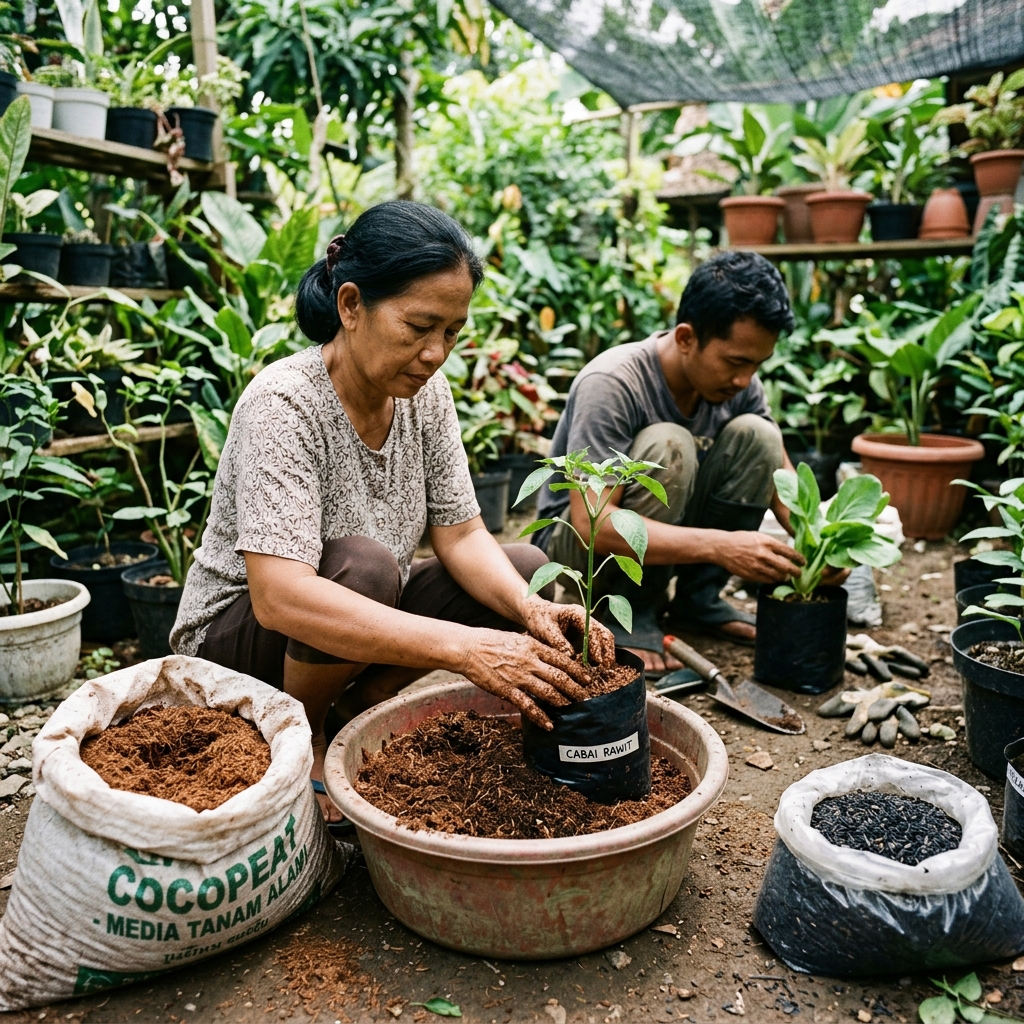
Looking for a complete cocopeat guide the best way to optimize your plantation or ornamental plant growing media? Cocopeat, or coconut coir dust, has become the top choice for modern farmers and plant hobbyists thanks to its ability to retain water and maintain maximum soil porosity.
In today's sustainable agriculture sector, the use of soilless growing media continues to surge rapidly. According to data from Food and Agriculture Organization (FAO), utilizing agricultural byproduct waste such as coconut coir can save irrigation water consumption by up to 30% in intensive horticulture cultivation.
This article serves as a complete cocopeat guide to help you understand its advantages, tannin leaching methods, application techniques as a soil substitute, through to its technical comparison with burnt rice husks.

Complete Cocopeat Guide: Definition and Key Characteristics
Cocopeat is an organic growing medium made from coconut shells and coir processed into high-quality pith powder. This natural material features a micro-sponge structure that is highly responsive to plant nutrient absorption.
Generally, cocopeat is processed from the extraction of coconut fiber (coir fiber). The remaining fine dust is sifted, dried, and sometimes compressed into block briquette forms for ease of domestic and export logistics distribution.
Organic Cocopeat Manufacturing Process
The cocopeat manufacturing process begins with separating the long fibers (coir fiber) from mature coconut husks. The separated fine dust then undergoes a natural fermentation phase to stabilize the acidity level (pH) and minimize inherent residues.
Based on research published by ScienceDirect regarding hydroponic growing media, the physical properties of cocopeat feature a total porosity of up to 90%, ensuring optimal oxygen circulation in the root zone without the risk of compaction.
Key Advantages in the Complete Cocopeat Guide
Using coco peat powder provides various technical added values that are hard to match by conventional soil media. Here are its primary advantages:
- High Water Retention Capacity: Able to absorb and retain water up to 8–10 times its dry weight.
- Eco-Friendly: Made from a renewable resource that is 100% naturally biodegradable.
- Near-Neutral pH: Features a natural acidity level in the range of pH 5.8 to 6.5, which is ideal for the majority of plants.
- Free of Soil Pathogens: Hygienically processed to minimize contamination from wild fungi, soil-borne nematodes, and weed seeds.
Functions of Cocopeat for Plants and Modern Growing Media
The application of cocopeat is not limited to the hydroponics sector; it is also highly effective for conventional agriculture, seed germination, and conditioning barren garden soils.
The primary function of cocopeat is as a structural conditioner for growing media. The presence of coco peat prevents the medium from becoming overly compacted from routine watering, allowing plant roots to develop freely without mechanical hindrance.
Optimal Water and Moisture Retention
High water retention makes cocopeat a vital solution in arid climates or during dry seasons. Water and nutrient solutions are held tightly within the matrix structure of the coir dust and released gradually (slow-release) according to plant needs.
A scientific study from an agricultural journal by IPB University demonstrates that incorporating cocopeat into growing media maintains consistent moisture levels for 24 hours longer than pure soil media.
Root Aeration and Rot Prevention
Despite its high water-holding capacity, cocopeat maintains air-filled porosity of around 10-12%. This is crucial for preventing anoxia, or oxygen deprivation, within the root zone.
Roots with adequate aeration are protected from root rot diseases caused by pathogenic fungi such as Pythium spp. and Phytophthora spp. Recent research published in the journal Nature Plants confirms that micro-oxygen supply in the rhizosphere significantly determines nutrient absorption efficiency.
Complete Cocopeat Guide: How to Properly Use It as a Soil Substitute
Using 100% pure cocopeat as a soil replacement requires specific treatment. This is because raw cocopeat is inert and lacks sufficient macro-nutrients (such as Nitrogen, Phosphorus, and Potassium).
Here are 7 tactical steps to complete cocopeat guide to fully replace soil functionality:
- Flushing Process: Wash raw cocopeat thoroughly with running clean water to leach out excess Sodium (Na) and Chloride (Cl) salts.
- Soaking and Tannin Neutralization: Soak cocopeat in a calcium nitrate solution or clean water for 12-24 hours to bind free tannins.
- Water Drainage: Squeeze and drain the cocopeat until it is moist (moisture content around 50-60%), neither too wet nor too dry.
- Organic Nutrient Mixing: Mix mature manure or compost at a 1:1 ratio to supply biological microorganisms and macronutrients.
- Addition of Porosity Materials: Add carbonized rice husk or perlite (2:1:1 ratio) to improve the drainage of the growing medium.
- EC and pH Measurement: Ensure the Electrical Conductivity (EC) value is below 0.5 mS/cm and the pH is in the range of 6.0 before planting.
- Routine Nutrient Application: Water plants periodically using a complete nutrient solution because cocopeat does not retain nutrients permanently.

Differences Between Cocopeat and Carbonized Rice Husk: Which Is Better?
Many novice growers are confused about choosing between cocopeat and carbonized rice husk. Both materials play complementary supporting roles, but their physical characteristics are very different.
Cocopeat excels in water retention and moisture, while carbonized rice husk excels in drainage rate, silica (Si) content, and natural carbon-binding properties.
| Parameter Criteria | Cocopeat (Coconut Coir) | Carbonized Rice Husk (Rice Husk Biochar) |
|---|---|---|
| Water Retention Capacity | Very High (800-1000%) | Sedang (200-300%) |
| Aeration / Porosity Level | Moderate – Good | Very High |
| Nutrient Content | Rich in natural Potassium, low in N & P | Rich in Silica (Si) and Carbon (C) |
| Media pH Level | Slightly Acidic – Neutral (5.8 – 6.5) | Neutral – Slightly Alkaline (6.5 – 7.5) |
| Organic Durability | Slow to decompose (2-3 years) | Very slow to decompose |
| Tannin Content | Present (requires initial washing) | None (free from inhibitor substances) |
The ideal combination for most horticultural plants is to blend both with a mix of 50% cocopeat and 50% carbonized rice husk to balance water retention and aeration.
How to Effectively Remove Tannins from Cocopeat
Tannin is a naturally occurring brownish polyphenol compound found in coconut coir. If left unwashed, tannins can inhibit nutrient absorption and stunt the growth of young roots.
To remove tannins completely, rinse the cocopeat with clean water until the runoff turns from dark brown to clear. This process is recommended by agricultural institutions such as the United States Department of Agriculture (USDA) to ensure the safety of coir-based growing media.
In addition to regular water, you can add 1-2 grams of Calcium Nitrate per liter of soaking water. Calcium will displace the Sodium and Tannin bonds, making the cocopeat inert and safe to use.
Penggunaan Cocopeat dalam Sistem Hidroponik dan Semai
Dalam sistem budidaya hidroponik substrat (drip irrigation), cocopeat merupakan media favorit untuk tanaman buah seperti tomat, cabai premium, dan melon. Kapasitas tukar kation (KTK) yang tinggi memungkinkan nutrisi diserap akar dengan stabil.
Untuk fase persemaian benih, kehalusan butiran cocopeat memudahkan akar halus merambat tanpa merusak struktur kecambah. Benih memiliki tingkat keberhasilan tumbuh (germination rate) lebih tinggi pada media cocopeat yang terjaga kelembapannya.

Inovasi Produk Turunan Kelapa dan Perkebunan Berkelanjutan
Selain dimanfaatkan sebagai media tanam langsung, industri kelapa dan kelapa sawit menghasilkan berbagai produk biomassa serta bahan baku bernilai tinggi untuk mendukung keberlanjutan pertanian global.
Pemanfaatan pupuk alami dan suplementasi nutrisi berbasis komoditas perkebunan terbukti meningkatkan produktivitas hasil panen secara signifikan. Penggunaan produk berkualitas seperti panduan lengkap cocopeat dan media tanam berkualitas kini semakin mudah diakses oleh para pelaku industri agribisnis.
Di samping itu, sektor industri pakan ternak dan energi hijau juga memanfaatkan produk sampingan perkebunan seperti Palm Kernel Expeller and Copra Meal sebagai pakan ternak bernutrisi tinggi, serta Palm Kernel Shell sebagai sumber energi biomassa ramah lingkungan. Formulasi nutrisi peternakan juga didukung suplemen energi efisien seperti Calcium Salts of Palm Oil Fatty Acids.
Makmur Amanah Sejahtera provides high-quality processed palm products such as Palm Kernel Expeller, Palm Kernel Shell, Crude Palm Oil, Palm Kernel Oil, and others. Please contact us via WhatsApp +6282140002198 or email admin@makmuramanah.co.id.
Frequently Asked Questions (FAQ)
Can cocopeat be used immediately without washing?
Tidak disarankan. Cocopeat mentah biasanya mengandung zat tannin dan kadar garam (sodium chloride) tinggi yang dapat menghambat pertumbuhan akar dan membuat daun tanaman menjadi menguning.
Berapa lama daya tahan cocopeat sebagai media tanam?
Cocopeat memiliki daya tahan pelapukan yang sangat baik, mampu bertahan 2 hingga 3 tahun di dalam pot tanpa mengalami pemadatan struktur yang ekstrem.
Apakah cocopeat mengandung unsur hara untuk tanaman?
Cocopeat murni secara alami kaya akan unsur Kalium (K), namun sangat minim kandungan Nitrogen (N) dan Fosfor (P). Oleh karena itu, penambahan kompos atau pupuk berkala tetap diperlukan.
Mana yang lebih baik untuk hidroponik, cocopeat atau rockwool?
Keduanya memiliki keunggulan tersendiri. Cocopeat lebih ramah lingkungan, ekonomis, dan dapat didaur ulang, sedangkan rockwool bersifat steril penuh namun membutuhkan penanganan limbah khusus.
Bagaimana cara mengatasi cocopeat yang terlalu jamuran?
Pastikan sirkulasi udara dan intensitas cahaya matahari cukup. Anda juga bisa menyiramkan fungisida hayati seperti Trichoderma spp. untuk mengendalikan pertumbuhan jamur merugikan pada media.
Conclusion
Cocopeat merupakan solusi media tanam organik ramah lingkungan yang sangat efektif meningkatkan kualitas perakaran dan efisiensi penyiraman. Dengan perlakuan pencucian tannin yang tepat serta kombinasi bahan pembenah tanah seperti sekam bakar, pertumbuhan tanaman Anda akan berlangsung lebih optimal dan subur.
Dengan menerapkan complete cocopeat guide ini, Anda dapat memaksimalkan potensi hasil panen perkebunan maupun keindahan tanaman hias secara berkelanjutan.




