
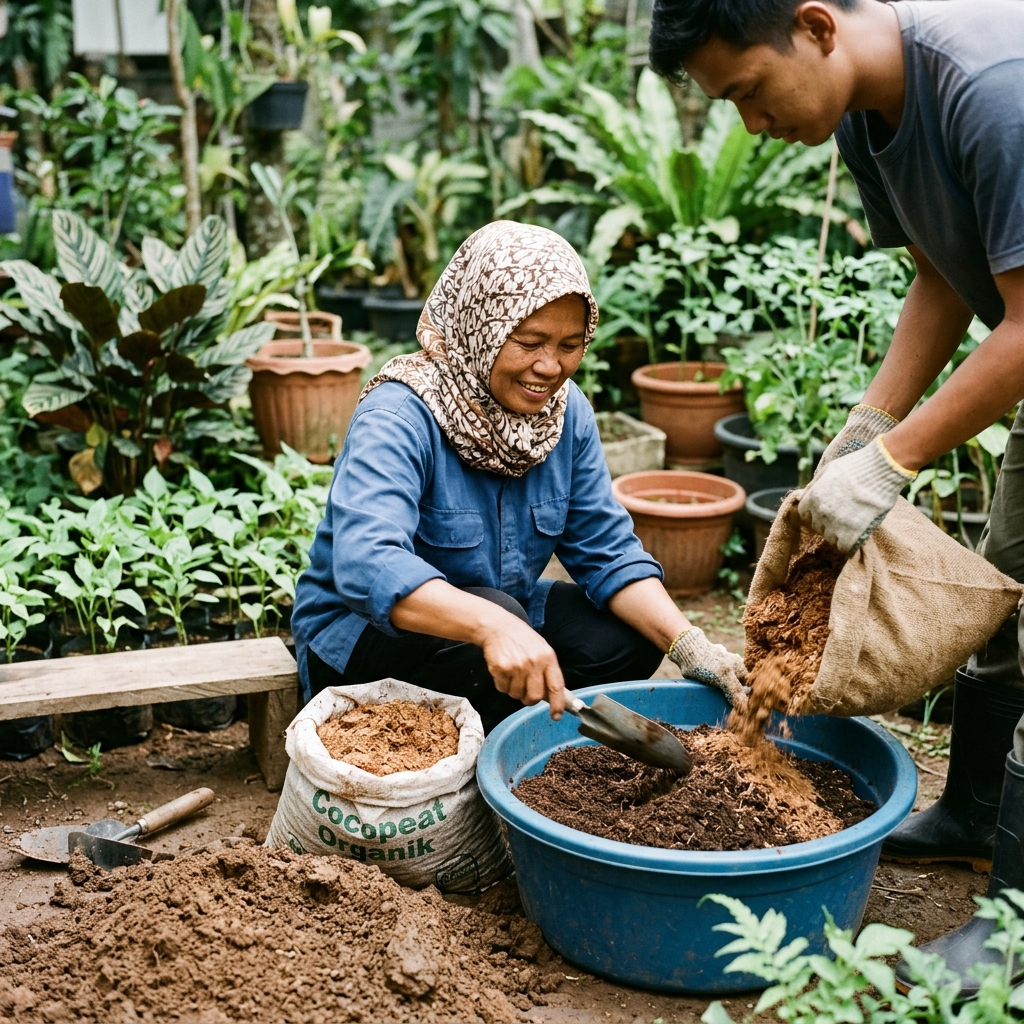
The practice of cocopeat mixed with soil is an advanced solution for botanists and modern gardeners to overcome planting medium issues such as easy compaction, airtightness, and poor oxygen circulation. Many plant owners face sudden yellowing leaves to root tissue death due to root systems lacking air cavities. Combining processed coconut coir with garden soil particles creates a balanced, loose, and eco-friendly physicochemical synergy.
The formula of cocopeat mixed with soil defined as a technique combining washed organic coconut coir fractions with fertile mineral soil to engineer porosity, retain moisture up to 800%, and prevent potting medium compaction. This synergy ensures that the plant's rhizosphere zone receives water supply and gas exchange simultaneously without leaving waterlogged puddles that trigger rot.

Scientific Reasons Why the Cocopeat-Soil Mixture Formulation Is Highly Recommended
Many beginners are often hesitant and wonder whether it is safe to combine coconut dust with regular garden soil. Research shows that clay or loam soils have a natural tendency to undergo structural compaction after repeated watering. When soil compacts, macro-aeration pores close tightly, abruptly halting the oxygen supply to root cells.
This is where coconut coir dust serves as an organic, resilient, and spongy soil conditioner (soil conditioner). Based on data from Food and Agriculture Organization (FAO), a prime-quality growing medium requires a balanced pore ratio between water holding capacity (micropores) and free gas exchange circulation capacity (macropores). Blending these two materials precisely meets these ideal parameters.
In addition to improving physical structure, the presence of processed coconut coir also boosts the Cation Exchange Capacity (CEC) of the growing medium. According to an agronomic study from University of Florida IFAS Extension, high-quality coconut coir fibers are capable of binding essential nutrient cations such as calcium, magnesium, and potassium, preventing them from easily leaching out through drainage holes during intensive watering.
Key Benefits of the Cocopeat-Soil Mixture for Plants
Applying the cocopeat mixed with soil method in a measured way brings tangible transformations to both the vegetative growth rate and generative flowering of your vegetation. This organic growing medium combination minimizes environmental stress while optimizing fertilizer uptake.
1. High Water Retention Without Inducing Rot
The hydrophilic sponge-like properties of coconut coir are able to bind water homogeneously across all layers of the planting container. Unlike clay soil, which turns into dense mud, moisture is released slowly (slow release) according to the plant's transpiration rate without leaving behind anaerobic, soggy puddles.
2. The Effect of the Cocopeat-Soil Mixture on Root Aeration
Dissolved oxygen is an absolute prerequisite for root cellular respiration to transport nutrients to stems and leaves. The addition of coconut fiber keeps the growing medium loose and porous, aggressively stimulating root cap elongation and preventing pathogenic bacterial colonies from multiplying.
3. Stabilizing Medium Temperature Fluctuations Under Scorching Sunlight
Scorching heat during the day often bakes the growing medium in plastic pots, triggering thermal stress in fibrous roots. Cocopeat acts as a natural thermal insulating layer that keeps root zone temperatures cool and stable.
4. Preventing Erosion and Shrinkage of the Growing Medium
Pure soil tends to shrink and pull away from pot walls when it dries out, causing watering to drain directly away along the edges without wetting the root system. A fertile soil composition enriched with cocopeat consistently maintains the medium's volume.
Ideal Mixing Ratios of Cocopeat Blended with Soil Based on Plant Type
Each plant group requires distinct levels of moisture and aeration. Therefore, the ratio of cocopeat mixed with soil for pots must be tailored to the root morphology of the commodities you cultivate.
| Commodity Category | Medium Composition Formula | Physical Characteristics | Key Physiological Benefits |
|---|---|---|---|
| Foliage Ornamental Plants (Aroids, Calathea, Philodendron) | 1 Part Cocopeat : 1 Part Soil : 1 Part Carbonized Rice Husk | Highly porous, moist and crumbly, high aeration | Prevents rhizome rot and leaf wilt |
| Leafy & Fruiting Vegetables (Chili, Tomato, Eggplant, Lettuce) | 2 Parts Cocopeat : 2 Parts Soil : 1 Part Organic Compost | Rich in organic matter, stable water retention capacity | Stimulates shoot growth and abundant fruit formation |
| Seed Sowing & Early Seedling Stages | 3 Parts Cocopeat : 1 Part Sifted Fine Soil | Very soft, friable, low mechanical resistance | Facilitates the penetration of the seed's radicle and hypocotyl |
| Cactus, Succulents, & Sansevieria | 1 Part Cocopeat : 2 Parts Soil : 2 Parts Malang Sand | Fast-draining, dominant macro-porosity | Eliminates the risk of watery stem base rot |
| Potted Fruit Plants (Citrus, Mango, Longan) | 2 Parts Cocopeat : 3 Parts Soil : 1 Part Husk & Compost | Sturdy structure, supports plant weight, stable nutrients | Anchors the fruit tree roots securely to prevent toppling |
To support commercial plantation needs as well as home hobbies, you can use export-quality coconut coir growing media from cocopeat Makmur Amanah Sejahtera which has been processed with strict quality control standards, has a very low salt content, and is practically ready to use.

Proper Steps to Process Cocopeat Before Mixing with Soil
Washing cocopeat before mixing it with soil is the most crucial step that must not be skipped. Raw coconut coir sourced directly from dehulling facilities retains high concentrations of chloride salts and concentrated tannin content. Tannins have allelopathic properties that inhibit new root growth, while high sodium triggers salinity stress.
- Fiber Decomposition and Hydration: Unpack the compressed coconut coir block, place it in a soaking container, and pour in clean water until fully submerged for 3 to 5 hours until the fibers fully expand.
- Tannin Washing: Discard the first soaking water, which is typically dark reddish-brown resembling concentrated tea. Wash and rinse the cocopeat using running water 3–4 times until the runoff water appears clear.
- Electrical Conductivity (EC) Measurement: Based on scientific studies in Scientia Horticulturae, an EC value of coconut coir media safe for plant root systems must remain below the 0.5 mS/cm threshold to prevent root cell plasmolysis.
- Calcium-Magnesium Buffering (Optional): Soak the clean coir in a Calcium Nitrate and Magnesium Sulfate solution for 12 hours to saturate the cation exchange capacity of the coir fibers, preventing them from absorbing plant calcium fertilizer later on.
- Squeezing and Air Drying: Squeeze the coconut coir until no water drips out. Spread it over a clean tarp in a shaded area until the moisture content reaches approximately 25–30%.
- Homogeneous Mixing: Mix the processed cocopeat with loose mineral soil and roasted rice hulls according to your targeted formulation ratio.
4 Fatal Mistakes When Using a Cocopeat Mixed with Soil Formulation
Although the effectiveness of cocopeat mixed with soil has been proven across various horticultural centers, technical errors in the field often backfire. Watch out for these four common mistakes to protect your plants from severe damage:
1. Using Dark Red Raw Coir
Raw, unwashed coir is rich in tannic acid and free phenols. These substances bind free nitrogen (N) in the soil, causing plants to show signs of chlorosis or pale yellowing leaves despite routine fertilization.
2. Excessively High Cocopeat Percentage in Outdoor Settings
Using more than 60% cocopeat for outdoor potted plants (outdoor) risks absorbing excessive rainwater. Saturated moisture triggers soil-borne fungal spores such as Phytophthora, Fusarium oxysporum, and Rhizoctonia attacking the stem collar.
3. Forgetting to Add Supporting Organic Fertilizer
Coco peat dust is an inert (inert) medium that lacks primary macro nutrients. When applying the mix cocopeat mixed with soil, you must include mature manure, vermicompost, or quality amendment residues such as copra meal and fermented residue of palm kernel expeller to enrich the soil's organic nutrients.
4. Ignoring the Drainage Gravel Layer at the Bottom of the Pot
A mixture of soil and fine dust can clog drainage holes at the bottom of the pot over time. Lining the bottom of the pot with wood charcoal or crushed palm kernel shell will permanently maximize the pot's drainage flow.

Substrate Performance Comparison: Pure Cocopeat vs Cocopeat Mixed with Soil
Many urban farming enthusiasts consider whether it is better to grow using pure coco coir in hydroponic systems or to use a blended mix. The following comparison table summarizes the essential performance differences between the two growing media:
| Evaluation Parameter | Pure Cocopeat (100%) | Cocopeat Mixed with Soil (50:50) |
|---|---|---|
| Original Nutrient Content | Sterile / Nutrient-free, strictly requires continuous AB Mix | Retains soil biology, natural minerals, and humates |
| Weight & Stem Support Capacity | Extremely lightweight, trees are prone to wobbling and lodging in the wind | Solid weight, firmly anchoring roots to keep plants upright and sturdy |
| Buffering Capacity | Low, prone to damage if fertilizer dosing errors occur | Very high, soil particles neutralize excess salts |
| Watering Frequency Requirement | Must be precise, slow to dry when placed in shaded areas | Highly balanced, possesses a natural wet-dry cycle rhythm |
| Medium Lifespan | 2 to 3 years before fibers fully degrade | 12 to 18 months before microbial rejuvenation is required |
Referring to scientific publications from Penn State University Extension, a coconut coir-based medium blend combined with mineral particles is proven to deliver superior nutrient buffering capacity against abiotic stress compared to single soilless media.
Recommended Educational Video: Watch an in-depth visual tutorial on how to wash tannins and master homogeneous mixing techniques for potting soil by searching on YouTube: “Tutorial Lengkap Olah Cocopeat Bebas Tanin untuk Campuran Tanah Kebun” to view a real EC test simulation.
Makmur Amanah Sejahtera provides high-quality processed palm products such as Palm Kernel Expeller, Palm Kernel Shell, Crude Palm Oil, Palm Kernel Oil, and others. Please contact us via WhatsApp +6282140002198 or email admin@makmuramanah.co.id.
Frequently Asked Questions (FAQ) Regarding Cocopeat Use
Can cocopeat mixed with soil be used immediately for planting?
Yes, provided the coco coir has been thoroughly washed of tannins and has an EC value below 0.5 mS/cm. If using raw coir, tannins will bind soil nutrients and poison your plant's young root cells.
What is the best ratio of cocopeat to soil for aglaonema?
The best ratio for aglaonema plants is 1 part clean coco coir, 1 part loose soil, and 1 part burned rice husk. This balanced formula maintains smooth air circulation while preventing soft stem rot on the rhizomes.
Why is white mold growing on my cocopeat and soil potting mix?
White mold grows due to oversaturated medium moisture and minimal room air circulation. Immediately reduce watering frequency, place the plant in an airy area with morning sunlight, or spray a bio-fungicide with the active ingredient Trichoderma periodically.
How long does a potted coco coir and soil planting mix last?
This formulated medium lasts optimally for 12 to 18 months in pots. After this period, the soil texture begins to compact again, so it is recommended to carry out repotting or add fresh organic matter periodically.
Can coco coir completely replace manure?
No, it cannot. Pure coco coir only acts as a soil conditioner to improve physical properties such as aeration and water retention. Coco coir does not contain essential NPK macronutrients like fermented manure does.
Conclusion: Key to Success in Mixing Fertile and Durable Growing Media
Creating a crumbly, oxygen-rich growing medium with balanced moisture retention is the foundation of gardening success. Formulations cocopeat mixed with soil that have been hygienically processed are proven effective in multiplying root growth vigor, maintaining root water supply, and protecting plants from the threat of deadly root rot.

Ensure that you always wash the coco peat until it is free of tannins, measure the blend proportions precisely according to the variety's characteristics, and incorporate supporting organic biofertilizers. Apply this blend method cocopeat mixed with soil to your garden right now to achieve lush, healthy plants with prime growth vitality throughout 2026!



