 บน บน by admin
RBD Palm Olein CP8: The #1 Ultimate Guide for 2025
สารบัญ
- What Exactly is RBD Palm Olein CP8?
- The 2025 Technical Specifications for RBD Palm Olein CP8
- Top Industrial Uses of RBD Palm Olein CP8
- RBD Palm Olein CP8 vs. CP10: The Ultimate Comparison
- The Bigger Picture: From Fruit to Refined Oil
- 3 Proven Reasons to Choose RBD Palm Olein CP8
- คำถามที่พบบ่อย
What Exactly is RBD Palm Olein CP8?
When navigating the world of edible oils, RBD Palm Olein CP8 emerges as a premier choice for countless applications. But what does this technical name mean? It stands for Refined, Bleached, and Deodorized Palm Olein with a Cloud Point of 8° Celsius. This specification makes it a highly stable and versatile liquid cooking oil, especially popular in temperate and cooler climates.
The “RBD” process ensures the oil is purified to create a bland-tasting, odorless, and light-colored product that won’t interfere with the flavor profile of food. The “Olein” part refers to the liquid fraction obtained from palm oil after a process called fractionation. The “CP8” is the critical identifier, signifying that the oil will remain clear and liquid until the temperature drops to 8°C, a vital property for food manufacturers and consumers.
The 2025 Technical Specifications for RBD Palm Olein CP8
Understanding the technical specifications of RBD Palm Olein CP8 is essential for quality control and ensuring it meets the standards for your application. These parameters define its purity, stability, and performance. While specifications can vary slightly by supplier, they generally adhere to internationally recognized standards.

Here are the key technical details you can expect in 2025, often aligned with standards from organizations like the Codex Alimentarius.
| พารามิเตอร์ | Specification |
| Free Fatty Acids (FFA) (as % Palmitic) | 0.1% max |
| Moisture & Impurities (M&I) | 0.1% max |
| Iodine Value (Wijs) | 57 min |
| Slip Melting Point | 24°C max |
| Cloud Point | 8°C max |
| Color (5¼” Lovibond cell) | 3 Red max |
Top Industrial Uses of RBD Palm Olein CP8
The unique properties of RBD Palm Olein CP8 make it a workhorse in the food industry. Its high smoke point and oxidative stability are prized for high-heat applications, while its neutral taste makes it a perfect base for a wide range of products.
- Deep Frying: From potato chips and instant noodles to french fries and doughnuts, its resistance to oxidation makes it a cost-effective and reliable frying medium, extending the shelf life of the final product.
- น้ำมันปรุงอาหาร: It’s bottled and sold directly to consumers and restaurants as an all-purpose liquid cooking oil, valued for its affordability and performance.
- เนยเทียมและไขมัน: It serves as a key liquid component in the production of table margarines, spreads, and shortenings, contributing to their texture and consistency.
- Confectionery & Baked Goods: It is used in creams, fillings, and coatings for confectionery items, as well as in recipes for biscuits and cakes to provide moisture and texture. Studies published on platforms like วิทยาศาสตร์โดยตรง often explore its versatile applications.
- Superior Performance in Cooler Weather: Its lower cloud point is the number one advantage, guaranteeing product liquidity and visual appeal in a wider range of environmental conditions.
- Exceptional Stability: Like all palm olein, it has a balanced fatty acid profile that provides excellent resistance to oxidation, which means longer-lasting frying life and increased product shelf stability.
- Cost-Effective Quality: It offers a perfect balance between performance and price. It provides many of the benefits of more expensive oils, like high stability, but at a much more competitive price point.
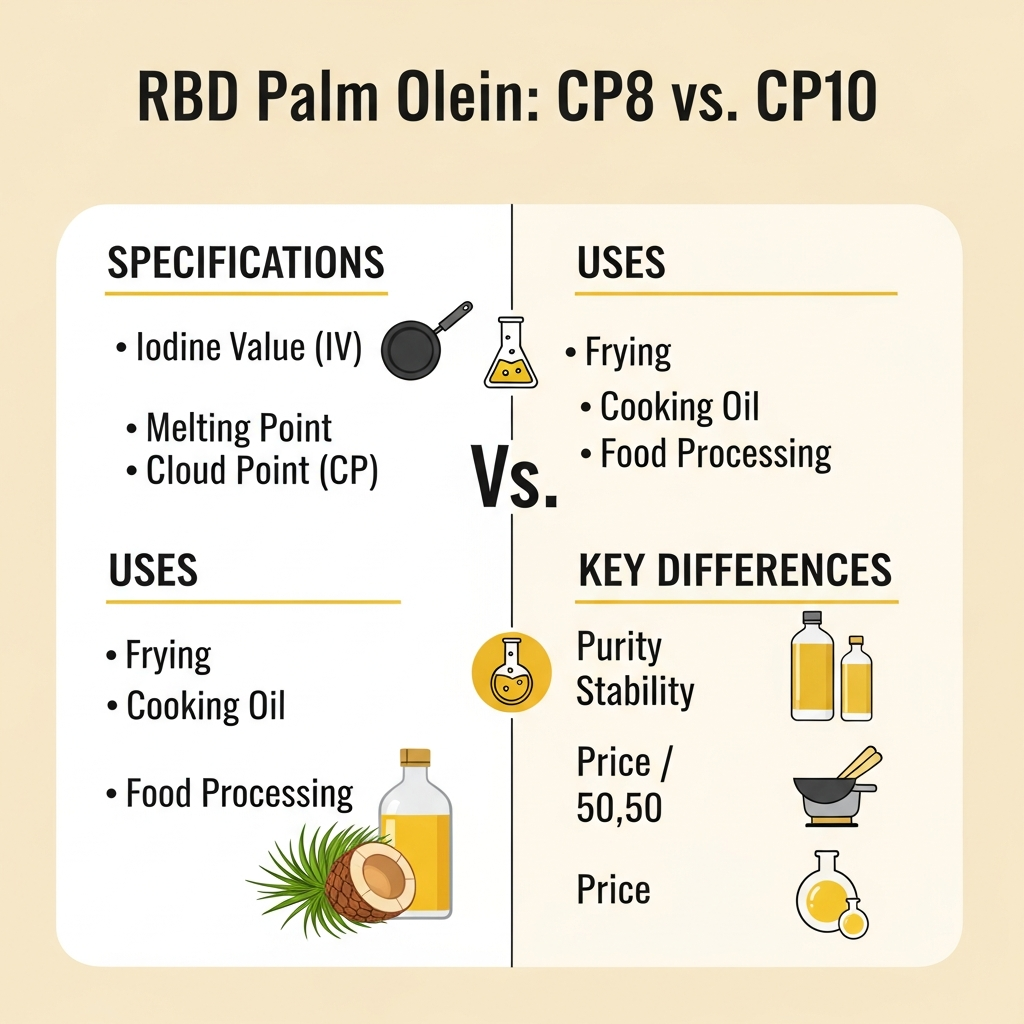
RBD Palm Olein CP8 vs. CP10: The Ultimate Comparison
The primary difference between RBD Palm Olein CP8 and its counterpart, CP10, lies in the cloud point. This single factor dictates their suitability for different climates and applications. CP10, or Cloud Point 10°C, will start to solidify and turn cloudy at a higher temperature than CP8.

Here’s a breakdown of the critical distinctions:
| คุณสมบัติ | RBD Palm Olein CP8 | RBD Palm Olein CP10 |
|---|---|---|
| Cloud Point | Remains liquid down to 8°C | Becomes cloudy at 10°C |
| Best Climate | Temperate and cooler regions | Tropical and warmer regions |
| Processing | More extensive fractionation | Standard fractionation |
| Iodine Value (IV) | Slightly higher (typically 57+) | Slightly lower (typically 56+) |
| ค่าใช้จ่าย | Slightly more premium | Generally more economical |
Essentially, choosing RBD Palm Olein CP8 is a strategic decision for markets where ambient temperatures can drop, preventing the oil from solidifying on the shelf or in the warehouse.
The Bigger Picture: From Fruit to Refined Oil
RBD Palm Olein is just one of the many valuable products derived from the oil palm. The journey begins with the harvesting of the ช่อผลปาล์มน้ำมัน, from which the initial น้ำมันปาล์มดิบ is extracted. The fruit’s seed, the เมล็ดในปาล์ม, is then processed to produce high-quality ปาล์มของเคอร์เนลน้ำมัน. This comprehensive process also yields valuable co-products like ปาล์มของเคอร์เนล Expeller สำหรับอาหารสัตว์และ ปาล์มเชลล์เคอร์เนล for biofuel, showcasing the efficiency of the palm oil industry.
3 Proven Reasons to Choose RBD Palm Olein CP8
Beyond its technical advantages, there are compelling reasons why businesses consistently select RBD Palm Olein CP8 for their production lines.
Makmur Amanah Sejahtera จำหน่ายผลิตภัณฑ์ปาล์มคุณภาพสูง เช่น เครื่องบีบเมล็ดในปาล์ม เปลือกเมล็ดในปาล์ม น้ำมันปาล์มดิบ น้ำมันเมล็ดในปาล์ม ฯลฯ กรุณาติดต่อเราได้ที่ WhatsApp +6282140002198 หรือส่งอีเมลถึงเราที่ admin@makmuramanah.co.id
คำถามที่พบบ่อย
1. What does the “CP” in RBD Palm Olein CP8 stand for?
CP stands for “Cloud Point.” It is the temperature at which the oil begins to appear cloudy or hazy as it starts to crystallize and solidify. For CP8, this process begins at 8° Celsius.
2. Is RBD Palm Olein CP8 a healthy choice?
RBD Palm Olein CP8 is a stable cooking oil free of trans fats. Like all fats and oils, it should be consumed in moderation as part of a balanced diet. The องค์การอนามัยโลก (WHO) provides guidelines on dietary fat intake for overall health.
3. How is RBD Palm Olein sourced?
This oil is derived from the fruit of the oil palm tree. With growing global awareness, there is a strong emphasis on sustainable sourcing. Reputable suppliers often adhere to standards set by organizations like the Roundtable on Sustainable Palm Oil (RSPO), a topic covered by groups like the กองทุนสัตว์ป่าโลก (WWF).
 Thai
Thai  Indonesian
  English
  Chinese
  Dutch
Dutch  Arabic
  Vietnamese
  Turkish