
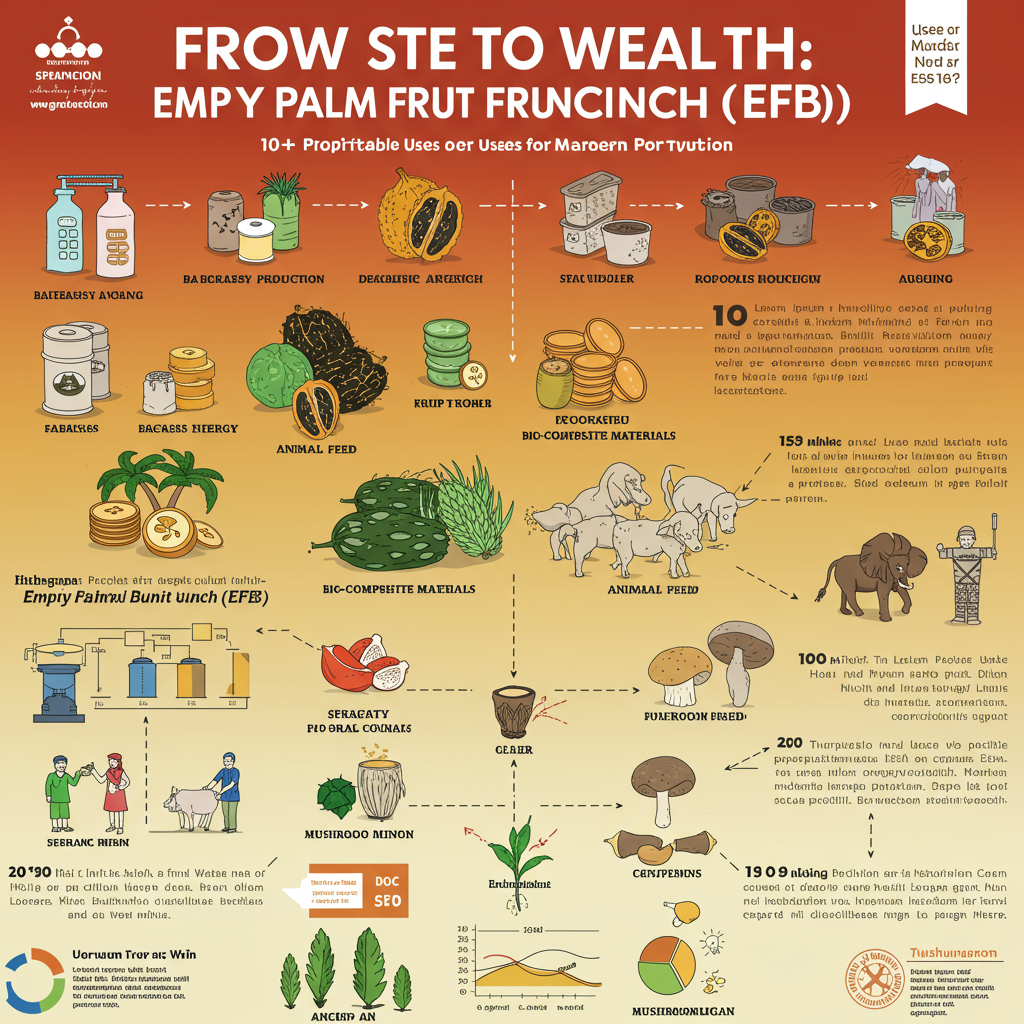
The palm oil industry, a titan of the global economy, generates a staggering amount of biomass waste from products like 粗棕榈油. Chief among this is the empty palm fruit bunch (EFB), the fibrous residue from the 油棕果串 left after the fruit and 棕榈仁 are harvested. For decades, this material was seen as a nuisance, often burned or left to rot. However, a paradigm shift is underway, revealing the incredible economic potential hidden within this “waste.” This guide explores the most profitable uses for empty palm fruit bunch, transforming a disposal problem into a cornerstone of a circular economy and highlighting the many valuable applications beyond the primary harvest.
目录
- 1. Bio-Energy: Key Uses for Empty Palm Fruit Bunch in Power Generation
- 2. Agriculture: Soil-Enriching Uses for Empty Palm Fruit Bunch
- 3. Eco-Materials: Manufacturing Uses for Empty Palm Fruit Bunch
- 4. Niche Applications: Innovative Uses for Empty Palm Fruit Bunch
- 您在可持续棕榈产品领域的合作伙伴
- Conclusion: The Future of EFB
1. Bio-Energy: Key Uses for Empty Palm Fruit Bunch in Power Generation
Perhaps the most immediate and profitable of all uses for empty palm fruit bunch is in energy production. EFB is a carbon-neutral fuel source that can significantly reduce reliance on fossil fuels, offering both economic and environmental benefits.

Direct Combustion for Power Generation
Many palm oil mills already use EFB as a solid fuel in their boilers to generate steam and electricity for their operations, often alongside other materials like 棕榈仁壳. This self-sufficiency model cuts energy costs dramatically. Modern co-generation plants can even produce surplus electricity to sell back to the national grid, creating a new revenue stream from waste. The diverse uses for empty palm fruit bunch in direct energy creation make it a cornerstone of sustainable mill operations.
Bio-Pellets and Briquettes
Raw EFB has high moisture content, making it inefficient to transport. By processing it into dried, compressed bio-pellets or briquettes, its energy density is vastly increased. These densified fuels are easier to handle, store, and transport, making them a viable commercial product for industrial boilers worldwide, particularly in countries looking to meet renewable energy targets. This is one of the most commercially viable uses for empty palm fruit bunch on the international market.
Biogas and Bio-methane Production
Through anaerobic digestion, EFB can be broken down by microorganisms in an oxygen-free environment to produce biogas, which is rich in methane. This biogas can be used for heating, cooking, or electricity generation. Further purification upgrades it to bio-methane, a direct substitute for natural gas, as detailed in studies by the Journal of Bioresource Technology.
2. Agriculture: Soil-Enriching Uses for Empty Palm Fruit Bunch
Beyond energy, the agricultural sector offers numerous high-value uses for empty palm fruit bunch. Its organic composition makes it an excellent resource for replenishing and protecting soil, showcasing its versatility.
High-Potassium Organic Compost
EFB is naturally rich in potassium (K), a vital nutrient for plant growth. Composting EFB creates a nutrient-dense organic fertilizer that improves soil structure, water retention, and microbial activity. This reduces the need for chemical fertilizers, cutting costs for farmers and promoting more sustainable farming methods.
Mulching for Crop Protection
When shredded, EFB serves as an excellent mulching material. Laid around the base of trees and crops, it helps suppress weed growth, conserve soil moisture by reducing evaporation, and regulate soil temperature. As it slowly decomposes, it releases valuable nutrients back into the soil, providing long-term benefits and representing one of the simplest uses for empty palm fruit bunch.
Sustainable Animal Feed
While raw EFB is too fibrous for most livestock, it can be processed into a palatable and nutritious animal feed. Treatments like steam explosion or fermentation break down the tough lignin and cellulose, making the nutrients accessible to ruminant animals like cattle and goats. This provides a low-cost, sustainable alternative to traditional feeds like 棕榈仁压榨机, diversifying feed options for farmers.
3. Eco-Materials: Manufacturing Uses for Empty Palm Fruit Bunch
The strong natural fibers within EFB are a valuable raw material for a variety of manufactured goods. These innovative uses for empty palm fruit bunch, beyond byproducts like 棕榈仁油, are paving the way for a greener manufacturing industry.
Pulp and Paper Production
The cellulose fibers in EFB can be pulped and used to produce paper, cardboard, and other packaging materials. This provides a sustainable alternative to wood-based pulp, helping to reduce deforestation. The viability of EFB in papermaking is a subject of ongoing research, which you can explore through resources like TAPPI (Technical Association of the Pulp and Paper Industry).
Fibreboard and Particleboard
EFB fibers can be mixed with a resin and pressed into medium-density fibreboard (MDF) and particleboard. These engineered wood products are widely used in furniture manufacturing and construction. Using EFB reduces the demand for virgin timber and offers a product with excellent strength and durability, making it one of the most practical industrial uses for empty palm fruit bunch.
Biocomposites for Manufacturing
最令人兴奋的事情之一 uses for empty palm fruit bunch is in the creation of biocomposites. EFB fibers are used to reinforce polymers, creating lightweight, strong, and biodegradable materials. These composites are being explored for use in automotive interior parts, consumer goods, and packaging, offering a green alternative to traditional plastics. Research in journals like 聚合物 highlights its potential in reducing plastic waste.
4. Niche Applications: Innovative Uses for Empty Palm Fruit Bunch
Beyond large-scale industrial applications, there are several specialized, high-value uses for empty palm fruit bunch that are gaining traction in various markets.
活性炭过滤
Through a process called pyrolysis, EFB can be converted into activated carbon. This material has a highly porous structure, making it an excellent adsorbent for water and air filtration systems. It can remove pollutants, odors, and impurities, serving a critical role in environmental protection, a process well-documented by environmental agencies like the 美国环保署.
Mushroom Cultivation
The sterilized, nutrient-rich fibers of EFB make it an ideal substrate for growing edible mushrooms, such as oyster mushrooms. This creates a high-yield, profitable agricultural business from a waste product, turning biomass into a direct food source. This application is one of the most creative uses for empty palm fruit bunch.
您在可持续棕榈产品领域的合作伙伴
正在寻找高品质的棕榈产品?
Makmur Amanah Sejahtera 提供高品质的棕榈产品,例如棕榈仁压榨料、棕榈仁壳、原棕榈油、棕榈仁油等。请通过 WhatsApp +6282140002198 或发送电子邮件至 admin@makmuramanah.co.id 与我们联系。.
Conclusion: The Future of EFB
The era of viewing the empty palm fruit bunch as waste is over. From powering homes and enriching soils to building furniture and filtering water, the profitable uses for empty palm fruit bunch are diverse and expanding. By embracing these circular economy models, the palm oil industry can not only mitigate its environmental impact but also unlock significant new revenue streams, truly turning waste into wealth.
 Chinese
  English
  Indonesian
  Arabic