目录
- 1. What Exactly is an Empty Palm Fruit Bunch (EFB)?
2. The Journey: How is an Empty Palm Fruit Bunch Processed?
3. Top 5 Revolutionary Uses of an Empty Palm Fruit Bunch
4. The Dual Impact: Environmental and Economic Benefits
5. What’s Next? The Future of Empty Palm Fruit Bunch Technology
6. Your Source for Sustainable Palm Products
7. 常见问题解答
The palm oil industry is a global giant, but its production cycle generates enormous amounts of biomass. For years, one of its primary byproducts was seen as mere waste. We’re talking about the 棕榈空果串 (EFB), the fibrous husk left behind after the valuable fruitlets—which are processed into 粗棕榈油 和 棕榈仁油—are harvested. This guide delves into how this humble agricultural residue is transforming into a valuable resource, championing sustainability and innovation.
1. What Exactly is an Empty Palm Fruit Bunch (EFB)?
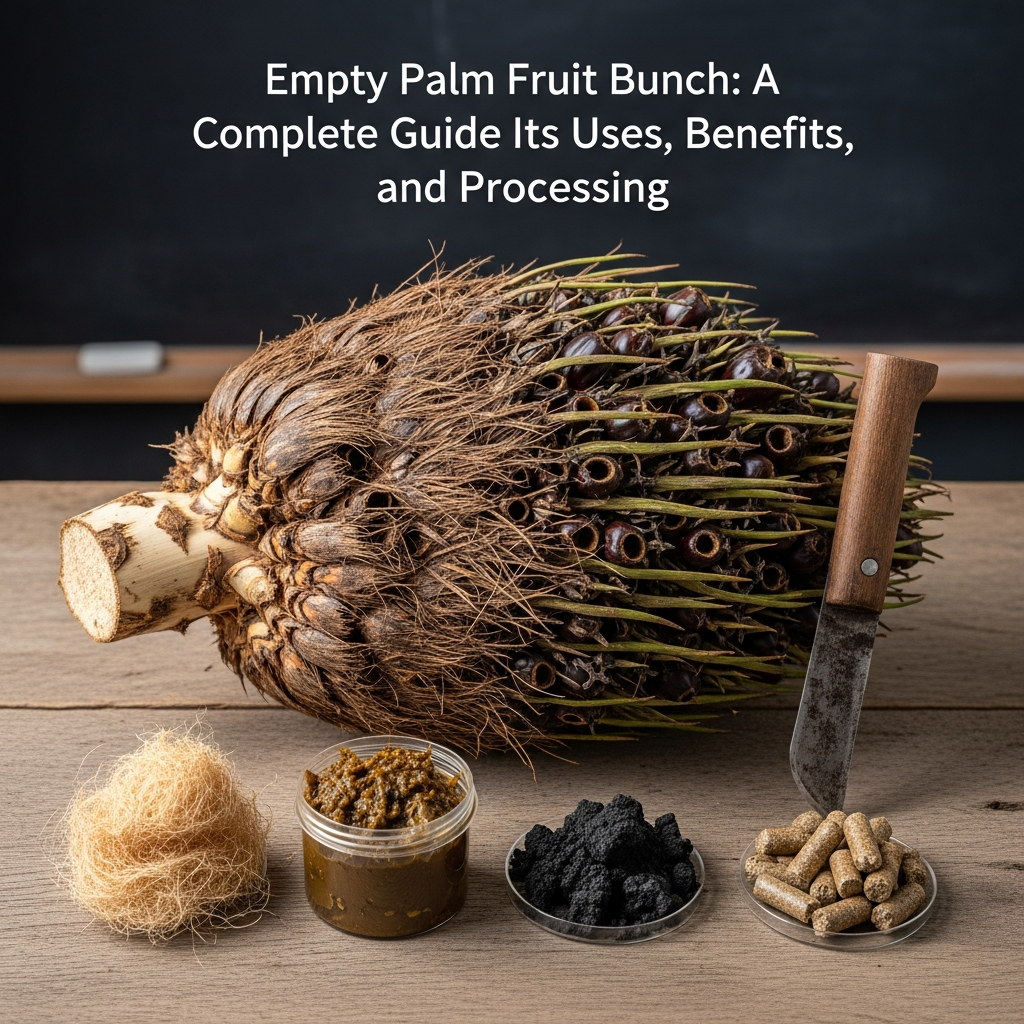
一个 棕榈空果串 is the stalk of the palm fruit, which becomes “empty” once the fruitlets (containing the valuable 棕榈仁) used for oil extraction are removed. These bunches are a lignocellulosic material, primarily composed of cellulose, hemicellulose, and lignin. They are tough, fibrous, and incredibly abundant in regions with significant palm oil cultivation.
Historically, EFB was either left to rot in plantations or incinerated, causing significant environmental concerns like greenhouse gas emissions and air pollution. However, a shift towards a circular economy has highlighted the immense, untapped potential of every single 棕榈空果串 produced.

2. The Journey: How is an Empty Palm Fruit Bunch Processed?
Transforming a raw, moisture-laden empty palm fruit bunch into a usable product requires a multi-step process. The primary goal is to reduce its size and moisture content, which can be as high as 60-70% initially. This makes it more efficient to transport and use as a feedstock for various applications.
步骤1:收集与撕碎
The process begins at the palm oil mill, where EFB is collected directly from the production line. It is then fed into shredders or chippers that break down the large, bulky bunches into a more uniform, smaller fiber size. This step is crucial as it increases the surface area, which aids in the subsequent drying process.
步骤2:脱水与干燥
After shredding, the EFB fibers are often pressed to mechanically squeeze out excess water. Following this, they are sent to a rotary dryer to reduce the moisture content to below 20%. Proper drying is essential for preventing decomposition and preparing the 棕榈空果串 fiber for its end use, especially as a biofuel. For more technical details on biomass processing, this study from ScienceDirect offers deep insights.
Step 3: Pelletizing (Optional)
For biofuel applications, the dried EFB fiber is often compressed into dense pellets or briquettes. This pelletizing process increases the energy density of the material, making it easier to handle, store, and transport compared to the loose fiber. These pellets are an eco-friendly substitute for coal in industrial boilers.
3. Top 5 Revolutionary Uses of an Empty Palm Fruit Bunch
The true value of an empty palm fruit bunch lies in its versatility. Advances in technology have unlocked numerous applications, turning this byproduct into a sought-after commodity.

1. 生物燃料与可再生能源
This is perhaps the most significant use. An 棕榈空果串 can be directly combusted in power plant boilers to generate electricity and steam, reducing reliance on fossil fuels. As a carbon-neutral fuel, it releases approximately the same amount of carbon during combustion as the palm plant absorbed during its growth. The 国际可再生能源机构(IRENA) highlights biomass like EFB as a key player in the global energy transition.
2. 堆肥与土壤调理
When composted, EFB decomposes into a nutrient-rich organic fertilizer. Its high organic matter content improves soil structure, water retention, and aeration, making it an excellent soil conditioner for agriculture. This practice returns vital nutrients to the soil, promoting healthier crop growth and reducing the need for chemical fertilizers.
3. 纸浆与造纸生产
The fiber from an 棕榈空果串 is a viable alternative to wood in the pulp and paper industry. Using EFB helps reduce deforestation and provides a sustainable source of raw material for producing paper, cardboard, and other packaging materials. Organizations like the 制浆造纸工业技术协会 (TAPPI) explore such non-wood fibers extensively.
4. Biocomposite Materials
EFB fibers can be combined with polymers to create biocomposite materials. These materials are used to make a variety of products, from furniture and automotive interior parts to decking and construction materials. They are lightweight, durable, and more environmentally friendly than traditional plastics or wood-based composites.
5. Mushroom Cultivation Medium
The sterilized and composted fiber of an empty palm fruit bunch serves as an excellent substrate for growing edible mushrooms, such as oyster mushrooms. The EFB provides the necessary nutrients and physical support for the mycelium to thrive, creating another value-added product from this versatile biomass.
4. The Dual Impact: Environmental and Economic Benefits
The proper utilization of the 棕榈空果串 offers compelling benefits. Environmentally, it mitigates landfill waste, reduces methane emissions from decomposition, and provides a renewable energy source that displaces fossil fuels. This approach is central to creating sustainable agriculture practices within the palm oil sector.
Economically, it creates new revenue streams for palm oil mills, reduces their waste disposal costs, and fosters job creation in collection, processing, and logistics. It’s a clear win-win, turning an environmental liability into an economic asset, as noted by the 联合国粮食及农业组织(粮农组织) in discussions about organic waste recycling.
5. What’s Next? The Future of Empty Palm Fruit Bunch Technology
The innovation surrounding the empty palm fruit bunch is far from over. Researchers are actively exploring advanced applications, including the production of biofuels like bioethanol, the extraction of valuable biochemicals, and the creation of nanocellulose for high-tech materials. As technology evolves, the 棕榈空果串 will play an even greater role in building a sustainable, bio-based economy.
6. Your Source for Sustainable Palm Products
正在寻找高品质的棕榈产品?
Makmur Amanah Sejahtera 提供高品质的棕榈产品,例如棕榈仁压榨料、棕榈仁壳、原棕榈油、棕榈仁油等。请通过 WhatsApp +6282140002198 或发送电子邮件至 admin@makmuramanah.co.id 与我们联系。.
7. 常见问题解答
Q: What is the main difference between an empty palm fruit bunch and palm kernel shells?
A: An 棕榈空果串 is the soft, fibrous stalk left after fruitlet removal. In contrast, a 棕榈仁壳 is the hard, woody covering of the fruit’s kernel. While both are excellent biofuels, EFB is also used for composting and fiber-based products. The kernel itself, once crushed for oil, produces another valuable byproduct: 棕榈仁压榨机, used in animal feed.
Q: Is using EFB for energy truly environmentally friendly?
A: Yes, it is considered a carbon-neutral process. The carbon dioxide released during combustion is part of the natural biogenic carbon cycle, unlike the burning of fossil fuels, which releases long-sequestered carbon into the atmosphere.
Q: How much energy can be generated from an empty palm fruit bunch?
A: The energy content (calorific value) of a dried 棕榈空果串 is typically around 16-18 MJ/kg. This makes it a potent fuel source for industrial boilers and power generation, significantly reducing the carbon footprint of energy production.