
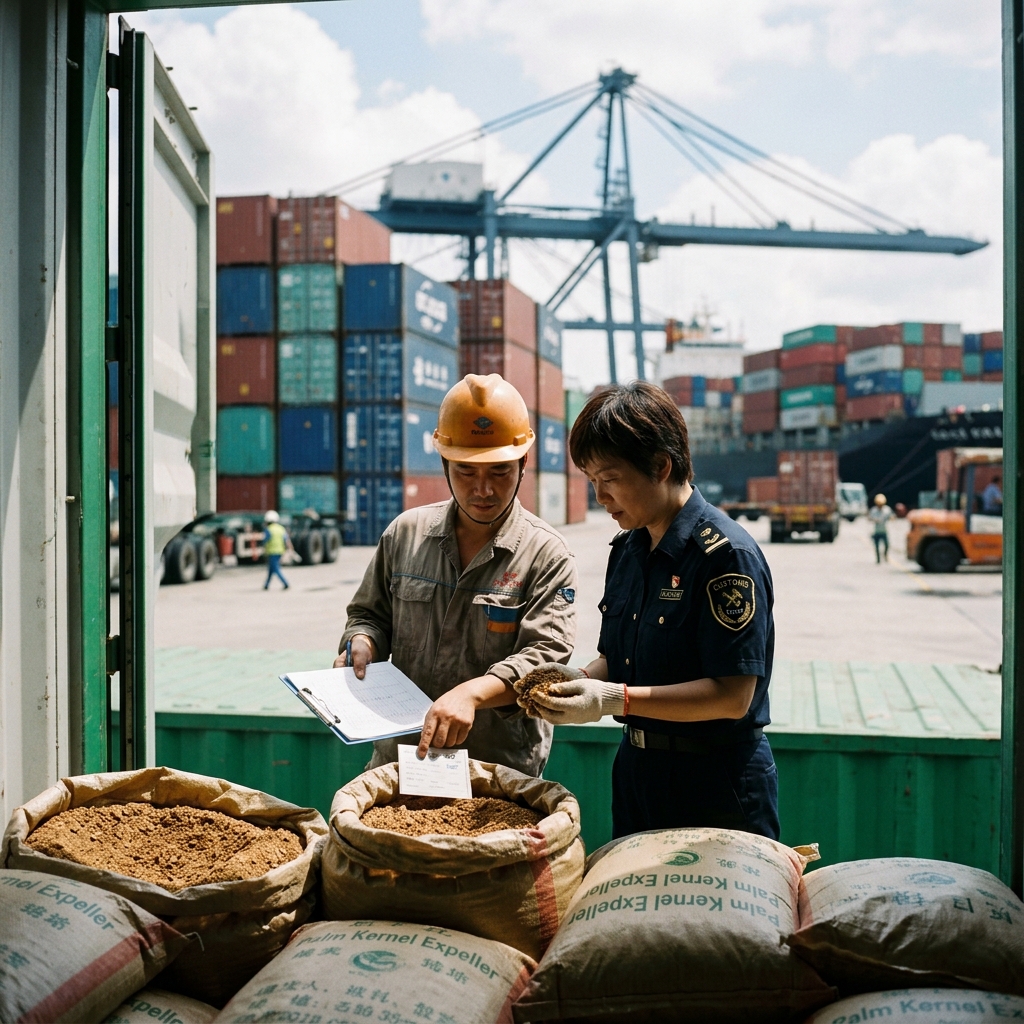
China GACC Approved Palm Kernel Expeller: Ultimate Sourcing Guide, HS Code & Import Compliance
Securing high-grade China GACC Approved Palm Kernel Expeller requires navigating strict customs regulations, phytosanitary requirements, and rigorous quality testing. As China expands its livestock feed sector, demand for economic, high-protein plant by-products like Palm Kernel Expeller (PKE) has surged across major entry ports including Qingdao, Tianjin, and Guangzhou.
However, non-compliant shipments face severe port delays, rejection, or mandatory destruction at Chinese customs entry points. According to trade regulatory updates from the General Administration of Customs of China (GACC), feed ingredient imports must originate exclusively from registered overseas production facilities to pass mandatory inspection and quarantine clearance.
This comprehensive guide covers everything feed mills, traders, and procurement managers need to know about sourcing GACC-compliant PKE, understanding HS code classifications, mastering Decrees 248 and 249, and optimizing supply chain efficiency in 2026.
Why Sourcing China GACC Approved Palm Kernel Expeller Matters for Importers
The Chinese General Administration of Customs enforces stringent regulatory frameworks to protect national biosecurity and livestock health. Any overseas facility producing animal feed ingredients must be officially audited, registered, and listed on the GACC Single Window system before shipping products to Chinese territory.
Importing unapproved feed meal carries severe commercial risk. Customs officials automatically reject bills of lading from unregistered producers, leading to catastrophic demurrage fees, vessel charter penalties, and container losses.
Furthermore, sourcing fully verified China GACC Approved Palm Kernel Expeller guarantees that the shipment meets heavy metal limits, aflatoxin restrictions, and moisture thresholds required by Chinese national agricultural standards (GB Standards).
Understanding GACC Decrees 248 and 249 Regulatory Framework
In recent years, China overhauled its food and feed import safety regulations through Decree 248 (Regulations on the Registration and Administration of Overseas Manufacturers of Imported Food) and Decree 249 (Administrative Measures on Import and Export Food Safety). Achieving full GACC Decree 248 compliance is mandatory for all foreign feed processors.
Under these rules, foreign processors of palm oil derivatives intended for animal feed must undergo formal recommendation by their home country’s competent authority (such as the Ministry of Agriculture in Indonesia) or submit direct applications depending on the specific product category.
- Facility Audit: Manufacturing facilities must demonstrate systematic hazard controls, such as HACCP or ISO 22000 certifications.
- Batch Traceability: Every batch must be traceable back to raw palm kernel crushing operations and raw material origin.
- Labeling Requirements: Packaging and outer jumbo bags must display the GACC registration number clearly alongside Chinese text declarations.
CIFRS System Registration and Manufacturer Verification
Importers must verify that their overseas supplier maintains an active listing on the China Import Food Enterprises Registration System (CIFRS). The registration record must explicitly cover feed ingredients under category HS 2306.60.
Failing to verify CIFRS registration palm feed details prior to loading often leads to immediate cargo re-export mandates upon arrival at Chinese ports.
[Image: Laboratory technician testing China GACC Approved Palm Kernel Expeller sample for moisture and protein content | alt=”Laboratory analysis of China GACC Approved Palm Kernel Expeller sample for protein and moisture compliance” | title=”GACC Approved Palm Kernel Expeller Quality Testing”]
Key Technical Specifications for China GACC Approved Palm Kernel Expeller
Palm Kernel Expeller is produced during the mechanical extraction of oil from the seed of the oil palm (油棕). It serves as an outstanding energy and medium-protein concentrate for beef cattle, dairy cows, sheep, and aquaculture feed formulations.
To pass inspection at Chinese entry ports, exported PKE must maintain balanced nutritional metrics while adhering strictly to toxicological thresholds set by China\’s Ministry of Agriculture and Rural Affairs (MARA).
Chemical Composition and Toxicological Thresholds
Chinese port authorities pay close attention to moisture levels and mycotoxin contamination. High moisture combined with residual fat creates ideal conditions for 黄曲霉 growth during ocean transport across warm equatorial sea routes.
Controlling aflatoxin B1 is paramount for bulk cargo. Chinese GB 13078-2017 feed hygiene standards limit aflatoxin B1 to maximum 20 ppb for commercial ruminant rations.
Comparative Analysis: Standard vs GACC Feed Grade PKE
| Nutritional / Technical Parameter | Standard Commercial Grade PKE | GACC Import Standard Grade |
|---|---|---|
| 粗蛋白(CP) | 14.0% – 16.0% | Min 15.5% – 16.5% |
| 蛋白质脂肪(蛋白质+脂肪) | 最小值 21.0% | Min 22.0% |
| 水分含量 | 最大 12.0% | Max 10.0% – 11.0% |
| 粗纤维 | Max 18.0% | Max 16.0% – 17.0% |
| Aflatoxin B1 | < 50 ppb | < 20 ppb (Strictly Enforced) |
| Sand & Silica / Ash | Max 5.0% | Max 3.5% – 4.0% |
Additionally, dairy nutritionists frequently combine PKE with concentrated fat sources like 棕榈油脂肪酸钙盐 to maximize energy density and milk fat yields without sacrificing rumen fiber digestion.
HS Code Classification and Customs Duties for China Imports
Correct Harmonized System (HS) code declaration is mandatory to avoid customs classification disputes, incorrect tariff payments, or clearance halts. The international classification standard maintained by the 世界海关组织 categorizes palm kernel residues under oilcake residues.
Tariff Classifications Under PKE HS Code 230660
Understanding the exact hs code for palm kernel expeller china customs clearance prevents administrative delays during entry filing. The main tariffs include:
- HS Code 2306.60.0000: Oilcake and other solid residues, whether or not ground or in the form of pellets, resulting from the extraction of palm nuts or kernels.
- Sub-heading 2306.60.0010 (Feed Grade): Specific sub-classification utilized by Chinese customs for animal feed processing applications under PKE HS Code 230660 protocols.
Under bilateral trade agreements between ASEAN countries and China, importers can utilize the China-ASEAN Free Trade Area (CAFTA) Form E certificate to secure 0% preferential import tariff rates.
Required Shipping Documentation for Expedited Port Clearance
When booking containers or bulk breakbulk vessels to China, the foreign seller must furnish an error-free documentation package. Paperwork discrepancies are the single leading cause of quarantine delays.
- Certificate of Origin (Form E): Issued by government authorities to qualify for zero-tariff treatment.
- 植物检疫证书: Issued by the exporting country\’s quarantine agency confirming freedom from live pests, weed seeds, and soil contamination.
- GACC Registration Declaration: Displaying active registration numbers for both exporter and processing facility.
- 分析证书(COA): Validating protein, fat, moisture, ash, heavy metals (Lead, Cadmium, Arsenic), and aflatoxins.
- 熏蒸证书: Proving effective phosphine or methyl bromide treatment prior to loading.
[Image: Indonesian palm crushing facility storing China GACC Approved Palm Kernel Expeller bulk export inventory | alt=”Indonesian palm crushing facility storing China GACC Approved Palm Kernel Expeller bulk export inventory” | title=”GACC Registered Palm Kernel Expeller Warehouse Storage”]
Step-by-Step Guide: How to Import Palm Kernel Expeller to China
Learning how to import palm kernel expeller to china requires establishing structured quality checkpoints across the procurement pipeline. Indonesia remains the largest exporter of palm kernel by-products, offering reliable volume stability for Chinese buyers.
Step 1: Partnering with a GACC Registered Palm Kernel Expeller Manufacturer Indonesia
Before issuing a Letter of Credit (LC) or paying advance deposits, verify the supplier on the official CIFRS system. Partnering with a verified gacc registered palm kernel expeller manufacturer indonesia ensures that all production facility audits comply with Chinese hygiene mandates.
Facilities must maintain clean processing lines to prevent pest harborages inside storage warehouses. Automated temperature monitoring systems are also required to prevent self-combustion in stored expeller bulk piles.
Step 2: Quality Inspection and Pre-Shipment Testing Protocols
Implement mandatory third-party lab testing (such as SGS, Sucofindo, or Intertek) at the port of loading (e.g., Belawan, Dumai, or Surabaya). The testing protocol must evaluate key safety parameters, including heavy metals, pesticide residues, and microbial contamination like 沙门氏菌.
Importers often diversify their agricultural feed procurement by sourcing alternative protein and fiber sources like high-grade 椰干粉 alongside palm kernel expeller to balance feed rations effectively.
Step 3: Ocean Logistics, Moisture Control, and Cargo Handling
PKE contains residual oil (usually 6% to 8%) and moisture. During ocean voyages across humid equatorial zones to northern Chinese ports, condensation inside shipping containers can trigger mold growth and aflatoxin formation.
Work with experienced suppliers who utilize container desiccant bags, high-density polyethylene liners, and proper moisture reduction protocols during mechanical pressing. Furthermore, agricultural operations using organic growing media often import 椰糠 in parallel container shipments for greenhouse substrate preparation.
[Infographic: Complete step-by-step import workflow for China GACC Approved Palm Kernel Expeller from Indonesian crushing mills to Chinese port clearance | alt=”Infographic detailing China GACC Approved Palm Kernel Expeller import clearance process” | title=”Palm Kernel Expeller Import Flowchart”]
Biosecurity, Quarantine Standards & CIQ Inspection at Chinese Entry Ports
Upon vessel arrival at Chinese ports like Qingdao, Ningbo, or Tianjin, China Inspection and Quarantine (CIQ) officials inspect the cargo prior to customs declaration. Scientific research published by the 联合国粮食及农业组织(粮农组织) highlights that imported plant protein meals are subject to strict monitoring for quarantine pests and biological toxins.
Common Quarantine Hazards in Ruminant Feed Ingredients China
Chinese port authorities screen high-volume ruminant feed ingredients China imports for primary biosecurity threats. Cargo will be detained under quarantine if officers discover any of the following issues:
- Presence of live insects, storage beetles, or quarantine weed seeds.
- Aflatoxin B1 levels exceeding Chinese National Food Safety Standards (GB 13078-2017).
- Signs of spontaneous combustion damage, extreme charring, or moldy clumps.
- Discrepancies between the physical packaging labels and GACC CIFRS database entries.
Furthermore, livestock feed manufacturers should ensure that agricultural biomass waste used alongside feed supplies—such as 棕榈仁壳 for industrial boiler heating—is kept in separate storage zones to avoid cross-contaminating feed-grade expeller meal.
Port Inspection Workflow: Qingdao, Tianjin, and Guangzhou
Once the cargo arrives, CIQ inspectors take composite samples from various container points or bulk ship holds. Laboratory analysis typically takes 3 to 7 business days.
When tests confirm full parameter compliance, customs issues the Sanitary Certificate for Entry Goods, allowing the importer to release cargo into inland logistics networks.
Feed Formulation & Nutritional Value of Palm Kernel Meal Import China
The strategic growth of Palm Kernel Meal import China trade is driven by PKE\’s cost-effective nutritional profile. Technical studies on ruminant nutrition in the 乳品科学杂志 show that clean, mold-free PKE provides excellent neutral detergent fiber (NDF) digestibility, significantly reducing digestive acidosis in high-producing dairy cattle.
By substituting a portion of expensive soybean meal and corn in beef cattle diets with PKE, Chinese commercial feed mills achieve lower feed cost per kilogram of weight gain while maintaining ideal milk fat percentages in dairy operations.
[Video: Video breakdown explaining Chinese port customs clearance and CIQ inspection for China GACC Approved Palm Kernel Expeller shipments | alt=”Video guide covering China GACC Approved Palm Kernel Expeller customs inspection” | title=”PKE Import Customs Clearance Video Guide”]
常见问题解答
What is a GACC Approved Palm Kernel Expeller facility?
A GACC Approved facility is an overseas processing plant audited and registered by the General Administration of Customs of China under Decrees 248 and 249. Registration verifies that the mill meets strict Chinese biosecurity, hygiene, and feed safety standards required for legal entry into Chinese ports.
What is the correct HS Code for Palm Kernel Expeller imported into China?
The core global HS Code for Palm Kernel Expeller is 2306.60.00. Chinese customs declarations classify feed-grade expeller under 2306.60.0010. Presenting a valid ASEAN-China Form E Certificate of Origin grants a 0% preferential import tariff rate.
Why is moisture content critical when shipping PKE to China?
Moisture levels above 11% combined with residual oil cause microbial heating and mold growth during long sea transport. Excess moisture leads to elevated aflatoxin levels, triggering mandatory rejection or destruction by Chinese port quarantine (CIQ) inspectors.
How long does GACC registration remain valid for overseas feed producers?
GACC registrations granted under Decree 248 are valid for 5 years. Overseas processing facilities must submit renewal applications through their competent national agricultural authority 3 to 6 months prior to expiration to maintain active export listing.
Can PKE be imported into China in bulk vessels and containers?
Yes, PKE is imported in containerized jumbo bags with desiccants or in breakbulk cargo vessels. Breakbulk shipping is preferred by large-scale Chinese commercial feed mills to minimize freight expenses per metric ton on large volume orders.
结论
Navigating the Chinese import market for palm oil co-products requires thorough attention to technical specifications, documentation precision, and biosecurity regulations. Importers and procurement directors who align their supply chains with verified production plants avoid costly customs delays while building a stable feed ingredient pipeline.
In summary, procuring certified animal feed ingredients demands absolute compliance with Chinese customs regulations. Partnering with a reliable exporter of China GACC Approved Palm Kernel Expeller guarantees clean port clearance, verified nutritional value, and long-term supply resilience for your livestock nutrition operations.
 Chinese
  English
  Indonesian
  Arabic