
How to Use Cocopeat for Plants: 7 Powerful Tips (2026)
Mastering how to use cocopeat for plants gives your garden an immediate advantage in moisture retention, root oxygenation, and disease prevention. Traditional soil often compacts, suffocating root tips and draining valuable fertilizers before flora absorbs them. By adopting premium coconut coir, you create an optimal environment where house plants, raised garden beds, and hydroponic setups flourish vigorously.
Agricultural research shows that unamended clay or degraded garden soil reduces root expansion by up to 45% compared to porous, aerated substrates. Modern horticulturists actively seek sustainable alternatives to depleted peat bogs, making coir the premier soil conditioner globally. Exploring modern methodologies teaches commercial growers and home hobbyists how to use cocopeat for plants to increase overall crop yield and streamline irrigation routines.
Cocopeat is a 100% natural growing medium manufactured from the fibrous outer husk of the coconut (椰子(Cocos nucifera)). When learning how to use cocopeat for plants, know that it acts as an ultra-absorbent sponge holding up to 8 to 10 times its dry weight in water while maintaining 25% air porosity. It provides a sterile, pH-balanced foundation ranging between 5.7 and 6.5, ideal for virtually all botanical species.
How to Use Cocopeat for Plants: Step-by-Step Preparation
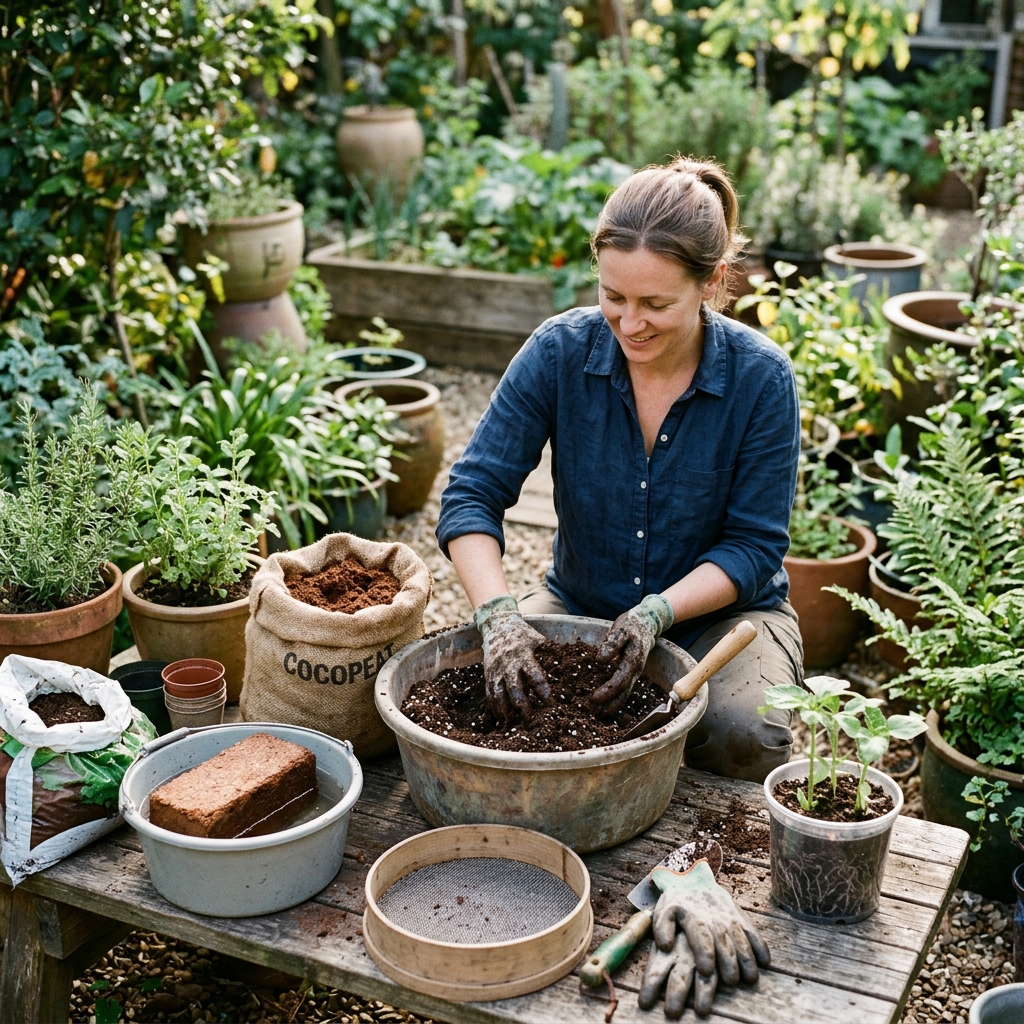
[Image: Rehydrating and expanding a compressed cocopeat block in a durable container filled with lukewarm water | Alt: Step-by-step demonstration of how to use cocopeat for plants by rehydrating a block | Title: How to Use Cocopeat for Plants Rehydration Process]
Raw compressed coir bricks require deliberate preparation before introducing delicate roots. Skipping the preliminary rinse or hydration phases introduces excess sodium salts and creates severe nutrient lockout. Follow these five mechanical steps to turn dense, compressed bricks into light, fluffy, root-ready medium.
- Hydrate the Compressed Brick: Place your dehydrated block into a 20-liter container. Add warm water gradually at a ratio of 4 liters of water per 1 kilogram of coir. Allow the expanding coco peat bricks to swell completely for 15 to 20 minutes.
- Break Up Clumps: Agitate the material by hand or with a garden trowel to ensure zero dry pockets remain. Fluffing the substrate maximizes porosity and softens stubborn clumps into a uniform texture.
- Flush Away Excess Salts: Natural processing near coastal areas leaves residual sodium in raw husk fibers. Run fresh tap or rainwater through the porous medium, draining the runoff thoroughly until electrical conductivity (EC) tests below 0.5 mS/cm.
- Buffer the Cation Exchange Complex: Unbuffered coir binds calcium and magnesium while releasing excess potassium. Soak the washed fibers in a solution containing calcium nitrate and magnesium sulfate for 12 to 24 hours.
- Drain and Squeeze: Drain the buffering liquid completely. Gently squeeze handfuls of fibers until moist like a wrung-out sponge, ready for blending or direct planting.
Executing this systematic preparation represents the single most crucial first step in how to use cocopeat for plants effectively. According to horticultural studies published by University of Florida IFAS Extension, untreated raw coir exhibits high electrical conductivity that stunt seedling development. Spending 24 hours on washing and buffering prevents costly root burn and yellowing foliage down the road.
[Video Embed: Practical walkthrough detailing rinsing, washing, and testing electrical conductivity in coconut coir | Title: Video Guide: How to Wash and Buffer Cocopeat at Home]
Buffering Explained: How to Use Cocopeat for Plants Without Nutrient Lockout
Advanced botanical science reveals that coconut husk fibers possess naturally negative electrical charges across their complex organic matrix. In raw coir, these cation exchange sites remain saturated with potassium and sodium cations. Without proper buffering, your substrate will chemically lock out calcium and magnesium fertilizers, causing rapid blossom end rot and stunted growth tips.
Mastering the science behind how to use cocopeat for plants requires addressing sodium and potassium displacement systematically. By saturating the rinsed fiber with a concentrated Cal-Mag agent, the stronger divalent calcium and magnesium ions replace weaker monovalent potassium ions. Academic findings indexed on 科学直接 confirm that pre-buffering coir substrates stabilizes cation balance, resulting in uniform nitrogen uptake throughout commercial tomato and pepper trials.
How to Wash and Buffer Cocopeat at Home Efficiently
To implement buffered cocopeat protocols at home without commercial equipment, you only require two 5-gallon utility buckets, a drill, and an inexpensive digital EC meter. Drill fine 2-millimeter drainage holes in the bottom of one bucket to create a nested straining sieve inside the solid bucket.
Dissolve 15 grams of agricultural-grade calcium nitrate and 10 grams of magnesium sulfate per 10 liters of warm water. Submerge your pre-rinsed coir in this bath for a full day, then pull up the nested colander bucket to drain the effluent cleanly. Understanding how to wash and buffer cocopeat at home guarantees commercial-tier results with zero guesswork.
Best Mix Formulations: How to Use Cocopeat for Plants Indoors and Outdoors
Pure cocopeat holds moisture brilliantly, yet it contains virtually no baseline macronutrients like nitrogen, phosphorus, or potassium. Consequently, horticulturists rarely use raw coir alone for long-term container gardening. Modern agronomists outline how to use cocopeat for plants across various potting blends by combining fibrous coir with perlite, organic compost, and aerating aggregates.
Different plant varieties possess unique drainage and oxygenation demands. Tropical houseplants require rapid root drying, whereas heavy-feeding outdoor vegetables demand persistent organic matter. The following custom potting formulas maximize health across your collection:
- Universal Houseplant Mix: Combine 50% buffered cocopeat, 30% perlite or pumice, and 20% worm castings. This formula demonstrates how to use cocopeat for plants in container gardening without risking destructive root rot.
- Moisture-Loving Vegetable Blend: Mix 40% expanded cocopeat, 40% aged compost, and 20% coarse horticultural sand. This rich blend provides steady water reserves during summer heatwaves while supporting vigorous microbe activity.
- Succulent and Cactus Substrate: Blend 25% fine cocopeat with 50% pumice, 15% lava rock grit, and 10% biochar. The slight coir inclusion cushions taproots without trapping dangerous, lingering wetness around root stems.
- Seedling Germination Medium: Use 80% finely sifted cocopeat mixed with 20% fine vermiculite. Commercial nursery managers explain how to use cocopeat for seed germination because its light resistance allows fragile radicles to penetrate smoothly.
Enhancing your custom blends with organic materials elevates microbial colonization substantially. While standard amendments work well, adding certified organic supplements like 椰干粉 infuses slow-release nitrogen and natural plant proteins. Furthermore, lining the bottom reservoir of substantial outdoor pots with heavy 棕榈仁壳 establishes outstanding perimeter aeration and prevents drainage hole blockages.
[Image: Comparison chart showing raw cocopeat, perlite, and organic compost mixed evenly on a garden potting bench | Alt: Mixing soil components demonstrating how to use cocopeat for plants in container mixes | Title: Potting Mix Ratios for How to Use Cocopeat for Plants]
Best Ratio of Cocopeat and Soil for Potted Plants and Containers
Determining the best ratio of cocopeat and soil for potted plants depends primarily on ambient atmospheric transpiration rates. For standard indoor decorative greenery, a balanced ratio of 40% cocopeat, 40% potting soil, and 20% coarse perlite yields the highest root respiration rates without drying out too rapidly.
For demanding patio containers exposed to direct afternoon sun, shift the proportion to 50% coir, 30% composted topsoil, and 20% perlite. This slight adjustment takes full advantage of cocopeat water retention properties, shielding your outdoor foliage against wilting shocks between watering cycles.
How to Prepare Cocopeat for Indoor Plants and Tropical Aroids
Discovering how to prepare cocopeat for indoor plants like Monstera deliciosa, Philodendron, , 和 Anthurium requires prioritizing drainage over moisture capacity. These epiphytic species suffer stem decay when subjected to dense, continuously waterlogged peat.
Screen your rehydrated coir through a 1/2-inch mesh to discard microscopic dust particles while retaining chunky husk fibers. Blend these coarse strands with orchid bark chips and coarse pumice to create an airy coco coir potting mix that mimics the porous jungle canopies these plants naturally inhabit.
Cocopeat vs. Peat Moss vs. Standard Topsoil
Deciding which substrate fits your greenhouse demands an objective analysis of physical and ecological characteristics. Traditional sphagnum peat moss takes centuries to form in delicate northern wetland biospheres, making harvesting environmentally destructive. Conversely, coconut coir represents a renewable agricultural byproduct that repurposes millions of tons of discarded fruit rinds annually.
The comparative table below highlights the critical horticultural metrics distinguishing these three common media:
| Feature / Characteristic | Cocopeat (Coconut Coir) | 泥炭藓 | Standard Topsoil |
|---|---|---|---|
| pH Range | 5.7 – 6.5 (Naturally neutral/mild) | 3.5 – 4.5 (Highly acidic) | 6.0 – 7.5 (Variable) |
| Water Retention Capacity | Holds 8–10x dry weight | Holds 10–12x dry weight | Holds 1.5–2x dry weight |
| Re-wetting Ability | Instantaneous rehydration | Hydrophobic when bone dry | Moderate (forms crust) |
| Air-Filled Porosity | High (20% – 25%) | Moderate (10% – 15%) | Low to poor (<10%) |
| Decomposition Rate | Very slow (high lignin content) | Moderate breakdown | Mineral (does not break down) |
| Ecological Sustainability | 100% renewable byproduct | Non-renewable carbon sink | Subject to topsoil erosion |
Data from environmental conservation groups published via 俄勒冈州立大学推广部 highlights how to use cocopeat for plants as a fully renewable substitute for peat moss. While peat moss requires agricultural lime to neutralize severe acidity, cocopeat sits comfortably within the golden absorption window for iron, zinc, and phosphorus.
Watering and Fertilization Protocols for Cocopeat Substrates
Adjusting irrigation schedules is vital when discovering how to use cocopeat for plants in indoor tents or exposed greenhouses. Because coir fibers retain high moisture levels while remaining visually light brown on the top millimeter, gardeners frequently make the mistake of overwatering. Always inspect your container weight or insert a finger two inches deep before opening your irrigation valves.
Unlike native mineral soils, coir acts as an inert growing medium. Consequently, specialized fertilizer protocols determine how to use cocopeat for plants without suffering nitrogen or micronutrient starvation. Supply complete, water-soluble hydroponic nutrients containing chelated trace minerals every second or third watering cycle.
Maintain nutrient run-off between 10% and 20% volume during heavy feeding phases. Flushing this excess liquid washes away accumulated salts and forces fresh oxygen through bottom root zones. In automated hydroponic benches, commercial greenhouse operators implement closed-loop fertigation systems tailored specifically to coir drainage kinetics.
Preventing Overwatering and Monitoring Moisture Levels
Because coco peat soil conditioner fibers hold water internally while allowing air to circulate between particles, gardeners misjudge soil saturation. The surface often turns a pale blonde hue within hours under high-intensity lights while root balls beneath remain saturated.
Lift your potted specimens before and immediately after drenching to establish an accurate physical baseline for container wet-weight. Alternatively, use a digital two-prong moisture probe inserted halfway down the root zone to prevent root asphyxiation.
How to Use Cocopeat in Hydroponic Systems and Raised Beds
Commercial greenhouse operations utilize distinct methods for how to use cocopeat for plants in recirculating benches, Dutch buckets, and slab drip channels. Because coir contains zero pathogenic fungi like 腐霉 或者 镰刀菌, hydroponic growers achieve high survival rates during initial vegetative cycles. Run-to-waste coir slab setups represent the gold standard for commercial tomato, cucumber, and strawberry production globally.
When selecting a reliable hydroponic growing medium, horticultural coir provides exceptional capillary action that distributes liquid fertigation evenly across horizontal root zones. This lateral wicking behavior prevents isolated dry channels, encouraging lateral root branching and maximizing secondary root development.
In outdoor raised garden beds, incorporating 30% coco peat transforms hard-packed earth into fertile, loamy soil. Dig coarse coir directly into your top 12 inches of existing garden soil in early spring. The high lignin content prevents rapid biological decomposition, ensuring superior aeration across multiple growing seasons.
Sustainable agricultural enterprises routinely balance coir beds with botanical and livestock-derived soil conditioners. Incorporating nutrient-dense organic supplements like 棕榈仁压榨机 into your broader outdoor bed composting cycles enhances organic carbon inputs and fuels healthy earthworm populations beneath the surface mulch. For high-performance agricultural formulations, supplementing compost piles with fatty acid fractions like 棕榈油脂肪酸钙盐 delivers concentrated organic caloric energy that stimulates thermophilic microbial activity.
Reusing and Sterilizing Cocopeat Between Growing Cycles
One primary economic advantage of coconut coir gardening involves its remarkable structural longevity. Sphagnum peat moss collapses into a muddy, anaerobic sludge after twelve months, whereas lignified coir lasts up to five years without losing physical structure. Knowing how to use cocopeat for plants repeatedly saves substantial capital over consecutive harvest seasons.
- Remove the Old Root Ball: Sift the spent growing medium through a coarse 1/4-inch hardware cloth screen to pull out fine roots, dead stems, and biological debris.
- Dissolve Bound Salts: Leach the substrate heavily with fresh water containing an enzymatic clearing solution. These enzymes break down residual dead root fragments into simple carbohydrates.
- Pasteurize or Solarize: Spread the damp coir onto a clean plastic tarp in full summer sunlight for 48 hours, or steam-pasteurize the material at 160°F (71°C) for 30 minutes to eradicate insect larvae and mold spores.
- Re-Buffer with Cal-Mag: Repeat a light calcium nitrate buffering soak to replenish any binding sites stripped during previous fertilization schedules.
Following this precise regeneration protocol ensures your recycled coir remains completely safe, vibrant, and pathogen-free. Veteran horticulturists verify that recycled coir frequently produces denser root structures than virgin materials because the fibers soften and settle into optimal pore diameters over time.
6 Common Mistakes When Using Cocopeat (And How to Fix Them)
Even seasoned horticulturists can stumble if they treat coconut coir identically to conventional potting soil. Avoid these six critical pitfalls when refining how to use cocopeat for plants:
- Neglecting to Rinse Raw Blocks: Unbranded coir blocks often harbor high sea-salt contents. Always test runoff water with a dependable TDS/EC pen before planting sensitive seedlings.
- Skipping the Buffering Step: Using unbuffered coir locks up valuable calcium, causing leaf margins to curl brown and crisp. Soak your fibers in a dedicated calcium-magnesium bath without exception.
- Overwatering Based on Top-Layer Color: Coir lightens quickly on the surface under intense grow lights while the center remains wet. Weigh pots manually to determine genuine hydration levels.
- Forgetting Supplemental Nutrients: Because pure coir is biologically inert, plants will starve if fed strictly plain tap water. Introduce gentle balanced fertilizers immediately after the first set of true leaves develops.
- Omitting Aeration Amendments: Fine coir dust retains significant water. Always blend 20% to 30% perlite, pumice, or rice hulls to safeguard against wet root compaction.
- Ignoring Runoff Buildup: Allowing potted plants to sit stagnant in nutrient drain trays leads to toxic salt crystallization at bottom pot tiers. Elevate containers on drainage risers.
To inspect premium quality substrates manufactured according to rigorous export standards, explore raw and processed grades of how to use cocopeat for plants through certified agricultural suppliers.
[Image: Healthy tomato and pepper plants thriving in a green raised garden bed amended with fluffy cocopeat | Alt: Garden bed displaying successful results on how to use cocopeat for plants outdoors | Title: Vibrant Garden Results Using Cocopeat Substrates]
Makmur Amanah Sejahtera 我们提供高品质的棕榈产品,例如棕榈仁粕、棕榈仁壳、原棕榈油、棕榈仁油等。请通过 WhatsApp 联系我们。 +6282140002198 或发送电子邮件至 admin@makmuramanah.co.id.
常见问题解答
Do you mix cocopeat with normal soil?
Yes, mixing cocopeat with native garden soil drastically improves soil structure. Combine 30% to 40% expanded coir with standard topsoil to loosen heavy clay, enhance aeration, and prevent sandy soils from losing water too rapidly in intense heat.
Does cocopeat need fertilizer before planting?
Yes, cocopeat contains zero natural macronutrients. You must pre-charge the medium with a diluted, balanced nutrient solution or blend it with organic compost and worm castings before planting to ensure seedlings receive adequate nitrogen and minerals.
Can plants grow in 100% pure cocopeat?
Plants can grow in 100% pure cocopeat exclusively within specialized hydroponic systems where every watering delivers balanced liquid nutrients. For conventional potted plants, blending 20% to 30% perlite is necessary to prevent root suffocation.
How often should you water plants grown in cocopeat?
Water plants in cocopeat when the top inch of the medium feels dry to the touch and the container feels noticeably light. In indoor environments, this usually means watering every 2 to 4 days depending on ambient humidity.
Can beginners easily adopt methods on how to use cocopeat for plants?
Absolutely. Beginners can easily manage how to use cocopeat for plants by purchasing pre-washed, pre-buffered coir bricks, blending them with organic compost, and adhering to steady watering schedules without requiring expensive monitoring tools.
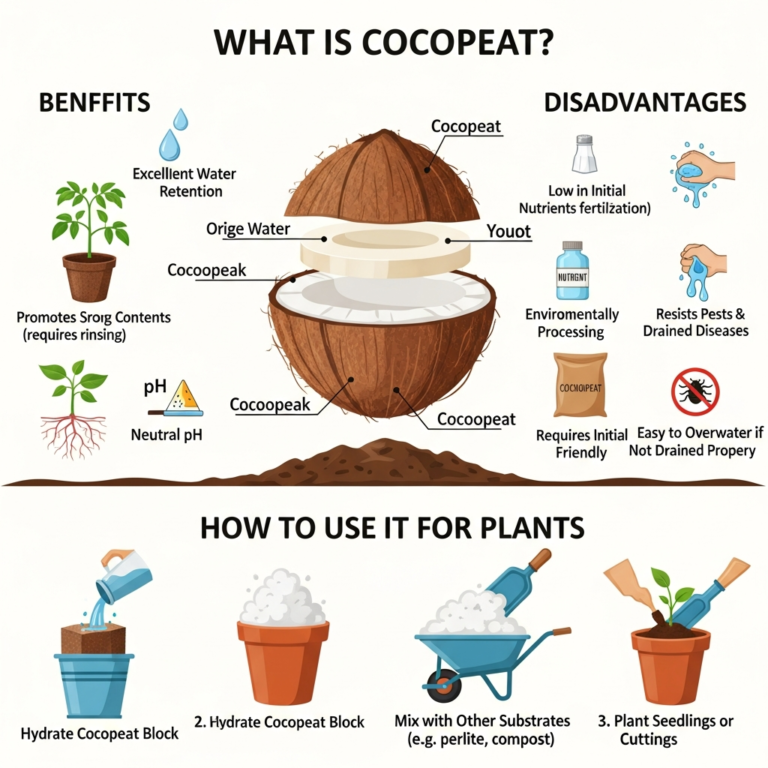
[Image: Infographic diagram outlining the complete lifecycle of cocopeat from coconut harvesting to household plant potting mixes | Alt: Detailed summary diagram showing how to use cocopeat for plants at home | Title: Visual Guide on How to Use Cocopeat for Plants]
Final Thoughts on Growing with Coconut Coir
Transforming your garden starts with selecting substrates that balance water retention with reliable aeration. Mastering how to use cocopeat for plants delivers superior moisture control, vigorous root architecture, and bountiful harvests across indoor foliage, annual florals, and commercial greenhouse crops alike. By rinsing away residual salts, buffering with calcium, and blending balanced amendments, you unlock the full botanical power of this sustainable substrate.
Whether you establish raised garden beds or upgrade indoor container pots, adopting renewable growing media fosters long-term horticultural resilience. Now that you understand exactly how to use cocopeat for plants, upgrade your growing medium today and watch your plants reach their ultimate genetic potential.
 Chinese
 English
 Indonesian
 Arabic
