
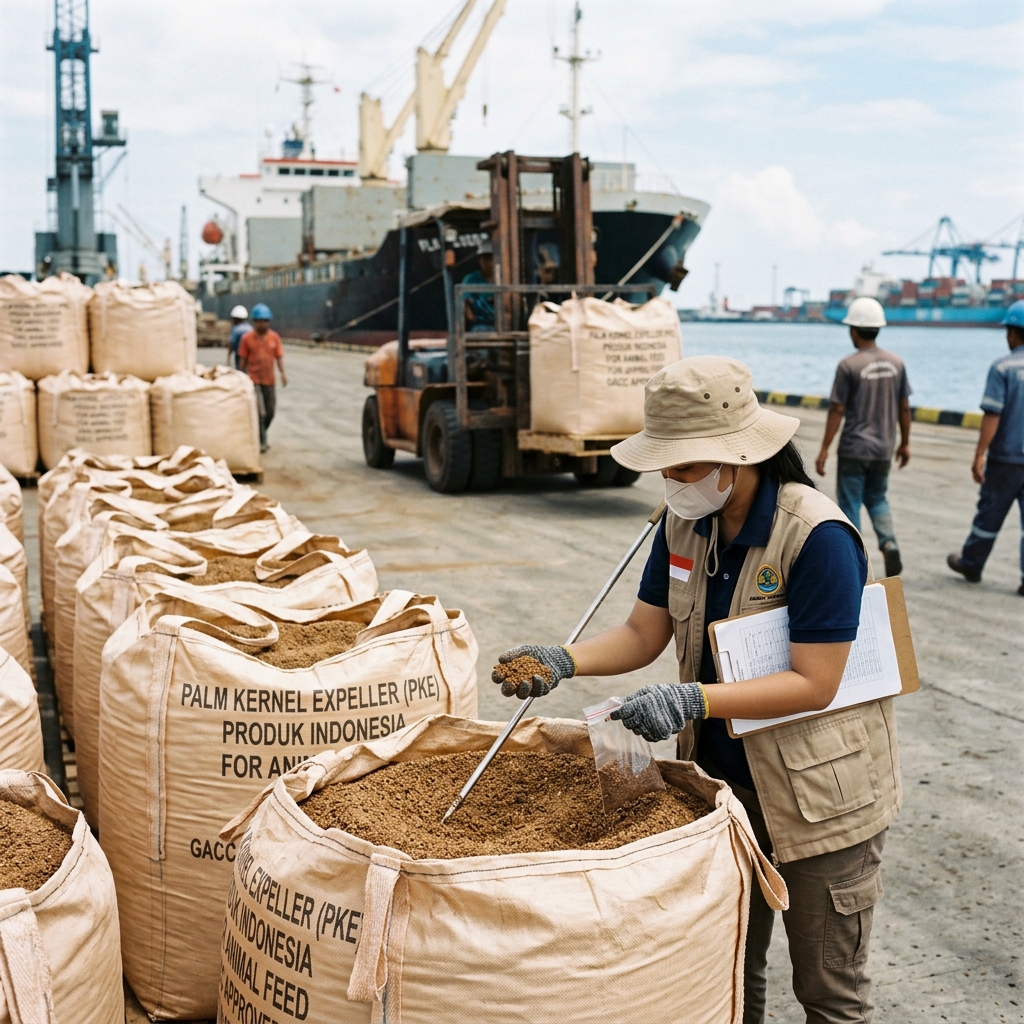
获得 GACC批准的印度尼西亚棕榈仁粕 对于寻求高蛋白、高性价比反刍动物营养的牲畜饲料进口商而言至关重要。全球饲料制造商越来越依赖认证的农业工业副产品,以满足奶牛和肉牛日粮日益增长的需求。
GACC批准的印度尼西亚棕榈仁粕 是一种优质高能动物饲料原料,由在中国注册的加工设施中通过油棕仁机械螺旋压榨提取制得。其粗蛋白含量为 15% 至 18%,残油率为 6% 至 10%,并含有丰富的膳食半纤维素纤维。
印度尼西亚仍是全球领先的棕榈油副产品生产国,供应全球 50% 以上的棕榈仁饼和粕。根据来自 联合国粮食及农业组织(粮农组织)的数据,国际市场对高能量植物饲料的需求每年增长 4.2%,从而推动了全球严格的质量合规标准。
中国海关总署(GACC)对入境饲料原料实施严格的生物安全和卫生要求。进口商若采购未经认证的产品,在中国目的港将面临货物被拒收、高额检疫罚款以及船期待港严重延误的风险。
了解GACC批准的印度尼西亚棕榈仁粕质量标准
采购 GACC批准的印度尼西亚棕榈仁粕 可确保商业饲料原料符合国际生物安全规程。原料源自破碎油棕果(油棕)的机械压榨提取,机械螺旋压榨保留了有益的残油水平,从而提高了整体代谢能。
China’s customs regulatory framework mandates that registered Indonesian processing mills maintain strict control over moisture content, heavy metals, aflatoxin levels, and pest contamination. Every shipment must carry dual phytosanitary and GACC registration certificates linked to verified processing facilities.
The physical composition of high-grade expeller consists of a brownish, coarse cake or pelletized form. Importers favor pelletized expeller because it reduces dust formation during bulk vessel loading and minimizes transit losses during long oceanic voyages.

Nutritional Profile of GACC Approved Indonesian Palm Kernel Expeller
Nutritional composition determines the feed efficiency and overall commercial value of agricultural byproducts in commercial livestock farming. Importers evaluate crude protein, crude fiber, and residual fat ratios before placing purchase contracts with Indonesian mills.
Scientific research published in ScienceDirect 农业研究 demonstrates that the fiber fraction in palm kernel expeller promotes healthy rumen fermentation in dairy cows. The moderate cellulose and fiber content acts as an effective dietary buffer against rumen acidosis.
The following technical breakdown highlights the typical laboratory specifications of certified crude protein animal feed exported under Chinese regulatory compliance:
- 粗蛋白: 15.0% – 18.0% minimum
- 粗脂肪 / 残留油分: 6.0% – 10.0% maximum
- 粗纤维: 最高 16.0% – 18.0%
- 水分含量: 10.0% – 12.0% maximum
- 蛋白质和脂肪总量(Profat): 22.0% minimum
- Aflatoxin (B1, B2, G1, G2): Max 20 ppb (parts per billion)
HS Code Classification and Global Trade Documentation
Navigating international customs requires exact tariff classification to avoid tariff miscalculations or port impoundment. The official international trade classification for this agricultural byproduct falls under the 世界海关组织(WCO) Harmonized System tariff code framework.
The primary 6-digit Harmonized System classification code for all palm kernel oil residues is HS Code 2306.60. Importers and customs brokers must verify specific national tariff extensions when declaring incoming bulk vessels in destination countries.
Detailed HS Code Structure for Palm Kernel Expeller
Customs authorities classify oilseed residues under Chapter 23 of the global tariff system. Understanding the exact breakdown helps importers prepare flawless bills of lading and origin documentation:
- HS 23: 食品工业的残渣及废料;配制的动物饲料。
- HS 2306: Oil-cake and other solid residues, whether or not ground or in the form of pellets, resulting from the extraction of vegetable fats or oils.
- HS 2306.60: Oil-cake and solid residues derived from palm nuts or kernels.
- Indonesian Export Tariff Code (BTKI): 2306.60.10 or 2306.60.90 depending on processing form (pelletized vs unground meal).
Customs officials audit documentation rigorously. When working with a GACC registered palm kernel expeller supplier Indonesia, ensure that all export invoices and origin declarations explicitly match HS Code 2306.60.
Comparing GACC Approved Indonesian Palm Kernel Expeller with Alternative Feeds
Livestock formulators continuously balance nutritional density against feed ingredient procurement costs. Selecting GACC批准的印度尼西亚棕榈仁粕 offers distinct commercial advantages over traditional ruminant livestock feed ingredients such as soybean meal, wheat bran, and coconut meal.
While soybean meal offers higher crude protein, its price volatility creates budgeting uncertainty for large-scale dairy and beef operations. Conversely, palm kernel expeller PKE provides a stable cost-per-unit energy ratio while adding valuable medium-chain fatty acids to animal diets.
Formulators often combine expeller feeds with supplementary energy ingredients like 椰干粉 or pass-through bypass fats like 棕榈油脂肪酸钙盐 to optimize milk fat yields in intensive dairy farming. Furthermore, processed agricultural substrates like 椰糠 are also produced under strict quality standards across Indonesia’s bio-resource sector.
The comparative matrix below outlines key technical parameters across popular commercial feeding choices:
| 范围 | GACC批准的印度尼西亚棕榈仁粕 | 豆粕(SBM) | 椰干粉 | 麦麸 |
|---|---|---|---|---|
| 粗蛋白 (%) | 15.0% – 18.0% | 44.0% – 48.0% | 20.0% – 22.0% | 14.0% – 16.0% |
| Crude Fat / Oil (%) | 6.0% – 10.0% | 1.0% – 2.0% | 6.0% – 8.0% | 3.5% – 4.5% |
| 粗纤维 (%) | 16.0% – 18.0% | 3.5% – 6.0% | 12.0% – 14.0% | 9.0% – 11.0% |
| 代谢能 (MJ/kg) | 10.5 – 11.5 | 12.5 – 13.5 | 11.0 – 12.0 | 9.5 – 10.5 |
| Rumen Fiber Digestibility | High (Hemicellulose-rich) | 中等 | 高 | 中等 |
| Price Relative Index | Economical / Low Volatility | High / Highly Volatile | 中等 | 中等 |

Step-by-Step Buying Guide for Importing GACC Approved Indonesian Palm Kernel Expeller
Importing bulk agricultural commodities requires careful compliance management, clear contract terms, and supplier verification. Follow our palm kernel expeller HS code export guide steps to ensure seamless execution when you buy GACC approved Indonesian palm kernel expeller from major shipping hubs.
1. Verify GACC Registration and Establishment Codes
Before issuing purchase orders, buyers executing a GACC registration China import must verify the supplier’s GACC registration number on the official Chinese customs portal (中国海关总署). Unregistered facilities cannot clear customs, resulting in cargo rejection.
Request copies of the exporter’s facility registration certificate issued by the Indonesian Agricultural Quarantine Agency (Barantan). Ensure the registration code listed on the phytosanitary certificate exactly matches the facility code in the GACC CIFER database.
2. Establish Technical Specifications and Contractual Terms
Draft detailed commercial contracts that specify exact moisture limits, oil content, and acceptable ranges for physical contaminants. Standard international contracts utilize FOSFA (Federation of Oils, Seeds and Fats Associations) contract templates tailored to palm oil residues.
Specify acceptable packaging methods based on your logistics infrastructure. Exporters typically offer three bulk loading formats:
- Break Bulk Vessels: Ideal for shipments ranging from 5,000 to 20,000 metric tons directly to deep-water ports.
- 大宗吨袋(800kg – 1000kg): Preferred by regional feed mills lacking bulk container unloader equipment.
- 20ft Bulk Container Liner Bags: Suitable for smaller, flexible orders ranging from 20 to 24 metric tons per container.
3. Conduct Pre-Shipment Inspection and Sampling
Contract an independent international cargo surveyor such as SGS, Sucofindo, or Intertek at the Indonesian loading port (e.g., Dumai, Belawan, or Panjang). Surveyors collect composite samples during vessel loading to verify safety compliance.
The surveyor generates official certificates of quality, weight, and sampling. Ensure that lab analysis confirms freedom from Salmonella, foreign matter, excessive silica/sand, and radiation before vessel departure.
4. Manage Export Logistics and Export Clearance
Indonesia enforces specific export duty rules and levy structures managed by the Oil Palm Plantation Fund Management Agency (BPDPKS). Exporters must settle all export taxes before customs issues the export clearance permit (PEB).
Importers should monitor international maritime shipping routes and weather patterns. Proper vessel hold ventilation during voyage prevents self-heating and condensation buildup inside bulk holds.
5. Execute Post-Arrival Import Quarantine Inspection
Upon arrival at the destination port, local customs officials review documentation including the Phytosanitary Certificate, Certificate of Origin (Form E for ASEAN-China FTA preferential tariffs), Heavy Metal Analysis, and Bill of Lading.
Clearing customs smoothly allows direct transportation to feed processing plants or bulk storage silos. Utilizing established ASEAN trade agreements reduces import duties under qualifying tariff lines.

Benefits of Ruminant Livestock Nutrition with Palm Expeller
Incorporating certified expeller feeds into livestock diets yields substantial biological and economic benefits. Dairy farmers report improved butterfat percentages, while beef cattle operations achieve higher average daily gain (ADG) figures.
Because the carbohydrates in palm kernel expeller consist primarily of insoluble mannan-based hemicellulose, fermentation proceeds at a controlled rate inside the rumen. This steady energy release minimizes lactic acid build-up and maintains optimal microbial health.
Furthermore, Indonesia palm oil byproduct energy utilization extends beyond animal feed. Industries also utilize energy-rich palm byproducts like 棕榈仁壳 for industrial biomass power generation and RBD CP8 olein for food processing applications.
Makmur Amanah Sejahtera 提供高质量的棕榈产品,例如: 棕榈仁压榨机, 棕榈仁壳、Crude Palm Oil、Palm Kernel Oil等。欢迎通过WhatsApp与我们联系 +6282140002198 或发送电子邮件至 admin@makmuramanah.co.id.
常见问题解答
What is the exact HS Code for Indonesian Palm Kernel Expeller?
The standard international Harmonized System (HS) code for Indonesian Palm Kernel Expeller is 2306.60. Indonesia’s national export tariff schedule (BTKI) further classifies this byproduct under subheadings 2306.60.10 for pelletized expeller or 2306.60.90 for unground meal forms declared on commercial shipping documentation.
How do I verify if an Indonesian supplier has valid GACC approval?
Importers verify GACC registration by querying China’s official Single Window CIFER portal. Enter the exporter’s assigned Chinese registration code or official business name under the approved overseas feed manufacturing enterprise database to verify active biosecurity compliance status before entering purchase contracts.
棕榈仁饼(PKE)与棕榈仁粕(PKM)有什么区别?
Palm Kernel Expeller (PKE) is produced via mechanical screw extraction, leaving beneficial residual oil levels between 6% and 10% for higher metabolizable energy. Palm Kernel Meal (PKM) undergoes chemical solvent extraction, resulting in lower residual fat content below 2%.
Why is GACC certification mandatory for importing feed into China?
GACC certification guarantees that foreign processing plants strictly adhere to Chinese biosecurity, sanitation, and chemical safety limits. Unregistered feed shipments face immediate quarantine rejection, forced destruction, or mandatory re-export upon arrival at Chinese destination ports under national customs law.
What is the shelf life and proper storage condition for bulk PKE?
Properly dried Palm Kernel Expeller with moisture below 12% maintains a shelf life of 6 to 12 months. Storage facilities must remain dry, well-ventilated, and protected from moisture penetration or pest infestation to prevent mold formation and aflatoxin contamination.
Conclusion: Partnering for Certified Agricultural Export Success
Procuring certified animal feed components requires meticulous adherence to regulatory protocols and physical quality controls. Sourcing high-grade GACC批准的印度尼西亚棕榈仁粕 provides feed manufacturers with a reliable, energy-dense solution for modern ruminant feed formulations.
By verifying GACC factory registrations, enforcing standard quality specs under HS Code 2306.60, and partnering with verified Indonesian exporters, buyers streamline international logistics and maximize livestock feeding margins in 2026.




