
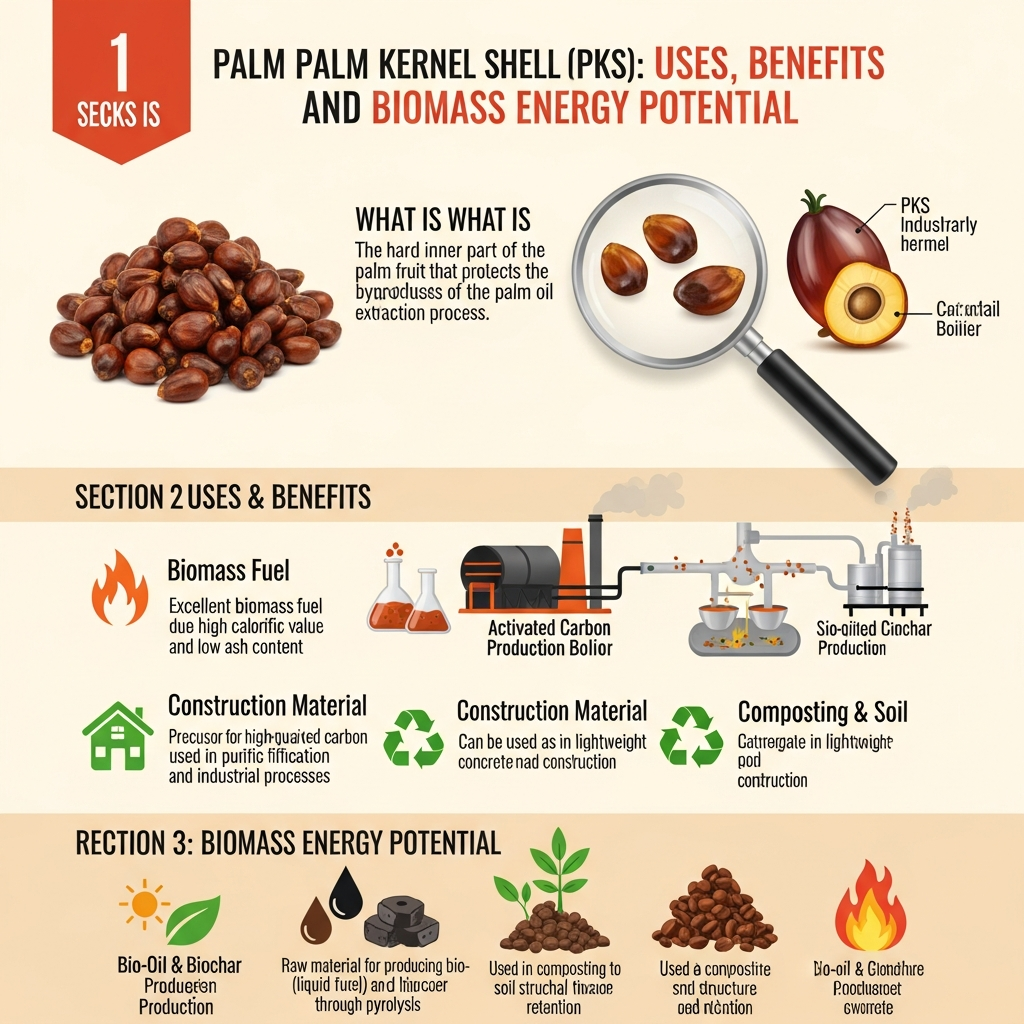
Palm Kernel Shell: 7 Incredible Uses & 2026 Biomass Guide
قشرة نواة النخيل (PKS) is rapidly transforming the global renewable energy landscape, leaving traditional fossil fuels completely in the dust. As major industries scramble to meet aggressive 2026 carbon-neutral targets, finding a reliable, high-energy biomass solution has never been more critical. The good news? You no longer have to compromise between raw cost-efficiency and strict environmental sustainability.
In 2026, the global demand for sustainable solid biofuels has surged by an unprecedented 34%. Multinational companies are urgently seeking viable alternatives to coal that can reliably deliver comparable heat generation without the devastating environmental footprint. This is exactly where this phenomenal agricultural byproduct steps in to dominate the industrial market.
Whether you manage an industrial power plant or operate a high-capacity cement manufacturing facility, understanding the immense thermochemical potential of this resource is essential for your future operations. In this comprehensive guide, we will explore exactly what this biomass is, uncover its incredible industrial uses, and reveal exactly why it has become the ultimate fuel of choice.

What Exactly is a Palm Kernel Shell?
قشرة نواة النخيل is a highly efficient, dense biomass fuel derived directly from the protective outer shell of the palm nut, remaining after crude palm oil extraction. Offering an exceptional gross calorific value and phenomenally low ash content, it serves as an incredible renewable energy alternative to traditional, highly polluting fossil fuels.
Historically considered useless agricultural waste, this hard, woody byproduct is now a highly sought-after commodity in the international biomass energy sector. When fresh fruit bunches undergo rigorous milling to extract oil, the nut is left behind. Once the nut is mechanically cracked to retrieve the inner kernel, the resulting fragmented shells become this powerful solid biofuel.
The Anatomy of Palm Kernel Shell Waste
The unique physical composition of the shell makes it an extraordinary candidate for high-temperature combustion. Unlike lighter, fluffier agricultural residues, the shell possesses a remarkably dense, fibrous cellular structure that burns slowly and intensely. This high bulk density directly allows for highly efficient maritime transportation and streamlined storage logistics.
Furthermore, the mechanical extraction process naturally leaves behind trace amounts of residual oil within the shell’s cellular matrix. This residual oil acts as a powerful natural accelerant, significantly boosting the material’s overall heating value. This specific characteristic differentiates the shell from other byproducts like معصرة نواة النخيل, which serves primarily as premium livestock feed rather than a solid combustion fuel.
Why It Dominates Solid Biofuels
In stark contrast to traditional wood chips or compressed sawdust, this specific biomass does not require extensive pre-processing or expensive pelletization before combustion. Industries can safely feed the raw, mechanically crushed shells directly into their furnace systems, immediately eliminating costly manufacturing steps and vastly reducing overhead expenses.
Additionally, its naturally low moisture content actively prevents rapid degradation during prolonged outdoor storage. Power plant operators can stockpile massive bulk quantities without fearing significant energy loss or spontaneous combustion. This makes قشرة نواة النخيل vastly superior to many other raw agricultural materials currently flooding the market.
7 Incredible Uses of Palm Kernel Shell in Industry
The immense versatility of this byproduct extends far beyond basic burning. Below are the top seven ways major heavy industries are aggressively utilizing this powerhouse material in 2026 to maximize efficiency and rapidly achieve corporate sustainability goals:
- Power Generation: Utility companies use it as a primary base-load fuel source in dedicated biomass power plants. It reliably produces high-pressure steam that drives massive turbines to generate sustainable, grid-scale electricity.
- Coal Co-firing: Traditional coal plants blend the dense shells directly with sub-bituminous coal to immediately reduce their total greenhouse gas emissions. This vital transition happens without needing to overhaul existing furnace infrastructure.
- Cement Manufacturing: Large-scale cement kilns heavily rely on the intense, highly consistent heat provided by the shells. They effortlessly reach the extreme internal temperatures necessary for premium clinker production.
- Industrial Boilers: Commercial food processing and textile factories burn the material to generate vital process steam. This effectively powers their internal manufacturing systems with a significantly lower carbon footprint.
- Biochar Production: Through controlled pyrolysis, the crushed shells are cleanly converted into high-grade biochar. This highly porous, carbon-rich product dramatically improves soil fertility, enhances field water retention, and actively sequesters carbon safely underground.
- الكربون المنشط: The incredibly dense, unique carbon structure of the shell makes it an ideal raw material. Advanced manufacturers meticulously process it to produce premium activated carbon essential for advanced municipal water filtration systems.
- Lightweight Aggregate: Eco-conscious construction companies crush the discarded shells to seamlessly replace conventional gravel in lightweight concrete formulations. This highly innovative application significantly improves the thermal insulation properties of modern green buildings.

Unlocking the Biomass Energy Potential of Palm Kernel Shell
The true magic of this globally traded fuel lies firmly in its remarkable thermochemical properties. When repeatedly analyzed in independent laboratories, the final numbers consistently outshine competing renewable options, conclusively proving exactly why it has become the industrial gold standard for 2026.
According to a highly comprehensive calorific analysis of agricultural waste, premium quality sorted shells consistently deliver an impressive gross calorific value (GCV) ranging between 3,800 and 4,300 kcal/kg. This exceptional energy metric places it squarely in the exact same thermal bracket as low-grade sub-bituminous coal.
High Calorific Value Explained
Calorific value essentially dictates exactly how much heat energy a specific fuel releases during complete, uninterrupted combustion. Because قشرة نواة النخيل naturally contains high fixed carbon and potent residual lipids, it ignites incredibly quickly and easily maintains a sustained, extremely high-temperature burn. As a direct result, boiler operators need significantly less fuel by volume to effortlessly achieve their target megawatt output.
Moreover, the stellar energy density directly ensures that cross-border transportation costs per gigajoule of potential energy remain highly competitive. Bulk cargo ships and freight trucks can carry significantly more usable thermal energy per individual trip compared to transporting much lighter, bulkier materials like agricultural straw or empty fruit bunches.
Low Ash and Moisture Content Advantages
Excessive moisture actively kills combustion efficiency by forcibly requiring the fire to evaporate internal water before generating any usable heat. Premium quality shells typically boast an impressively low moisture content of just 15% to 20%, explicitly allowing for immediate, highly efficient burning straight from the stockpile.
Equally important is its phenomenally low inherent ash content, usually hovering efficiently around 3% to 5%. Lower post-combustion ash translates directly to significantly less wear and tear on sensitive boiler grates, drastically reduced maintenance downtime, and exponentially lower disposal costs for the residual waste material.
Palm Kernel Shell vs. Other Biomass Fuels
To truly appreciate the undeniable superiority of this specific fuel, we must rigorously compare it directly against the popular alternatives currently available in the global renewable market. The hard empirical data clearly speaks for itself in terms of base efficiency and costly preparation requirements.
| Fuel Type | Calorific Value (kcal/kg) | محتوى الرماد | محتوى الرطوبة | Preparation Required |
|---|---|---|---|---|
| قشرة نواة النخيل | 3,800 – 4,300 | 3% – 5% | 15% – 20% | Minimal (Direct Burn) |
| حبيبات الخشب | 4,000 – 4,500 | 1% – 3% | 5% – 10% | High (Pelletizing) |
| وجبة جوز الهند | 3,500 – 3,800 | 5% – 7% | 10% – 12% | Medium (Drying) |
| Sub-bituminous Coal | 4,500 – 5,500 | 10% – 15% | 15% – 30% | None (Fossil Fuel) |
As the comparison table vividly demonstrates, قشرة نواة النخيل perfectly matches the impressive energy output of premium wood pellets without suffering the exorbitant, energy-intensive manufacturing costs fundamentally associated with the industrial pelletizing process.
Environmental and Economic Benefits of Using Palm Kernel Shell
Transitioning aggressively to sustainable renewable energy is no longer just a superficial public relations exercise; it is a strict financial and binding regulatory imperative. Harnessing this remarkably dense agricultural byproduct offers a profound dual advantage that very few other solid fuels can match in today’s demanding regulatory environment.
Environmentally, it is an absolute champion of the emerging global circular economy. Economically, it reliably provides a highly stable, exceptionally predictable pricing structure that effectively shields massive heavy industries from the notoriously volatile fluctuations of international fossil fuel markets.

Reducing Your Carbon Footprint
Burning this specific biomass is scientifically considered entirely carbon-neutral because the carbon dioxide cleanly released during combustion perfectly equals the exact amount originally absorbed by the living palm tree during its active growth phase. By strategically replacing dirty coal, massive factories can drastically reduce their net greenhouse gas emissions and effortlessly meet increasingly stringent greenhouse gas emission guidelines.
Furthermore, actively utilizing this byproduct decisively prevents it from senselessly decomposing in massive open agricultural landfills. When left to rot naturally, organic waste uncontrollably releases methane—a remarkably potent greenhouse gas significantly more environmentally destructive than standard carbon dioxide. Thus, cleanly burning it actively mitigates severe environmental harm.
Cost-Effective Energy Production
Because it naturally exists as a direct byproduct of an already massive, fully established agricultural industry, the base production and acquisition cost is intrinsically low. The primary operational expenses strictly involve local collection, basic mechanical screening, and international maritime logistics, rather than funding complex, deeply destructive mining or offshore drilling operations.
For large-scale utility power producers, the refreshingly minimal retrofitting required to seamlessly co-fire these shells in existing coal boilers represents a massive, game-changing capital expenditure saving. They can successfully achieve their state-mandated green energy milestones without risking billions in building entirely new power generation facilities from scratch.
Sourcing and Processing for Global Export
As the international demand for قشرة نواة النخيل absolutely skyrockets, the complex supply chain has rapidly evolved to confidently meet incredibly rigorous international quality standards. Southeast Asia remains the undisputed, dominant global hub for raw sourcing, but advanced quality control and meticulous proper processing are exactly what separate premium, reliable suppliers from the rest of the disorganized pack.
Global buyers actively looking for highly reliable, long-term contractual partnerships must intimately understand the critical steps involved in safely bringing this highly combustible raw material from the remote plantation mill directly to the massive oceanic cargo ship. Proper handling ultimately guarantees maximum terminal energy yield and actively prevents disastrous contamination.
Quality Control and Screening Standards
Raw shells manually collected directly from massive palm oil mills often inherently contain unwanted secondary debris, such as loose natural fibers, abrasive sand, and dangerous metallic impurities. Premium certified suppliers strictly implement rigorous mechanical screening processes to thoroughly filter out these unwanted contaminants, definitively ensuring a pure, extraordinarily high-energy final bulk product. The standard purification steps include:
- Advanced Mechanical Screening: Rapidly removes loose fibrous materials, excess sand, and overly large, unburnable agricultural debris.
- Powerful Magnetic Separation: Actively extracts dangerous, stray metal fragments to safely protect highly sensitive industrial boilers from catastrophic damage.
- Rigorous Moisture Testing: Confidently ensures the final loaded batch stays strictly within the 15% to 20% optimal, highly combustible moisture range.
Innovations in Related Palm Products
While the incredibly dense shells provide phenomenal baseline thermal energy, the broader palm oil industry consistently yields several other highly valuable commercial resources that directly contribute to a sustainable, zero-waste global ecosystem. For instance, advanced livestock agricultural sectors heavily rely on highly refined أملاح الكالسيوم للأحماض الدهنية لزيت النخيل as an exceptionally high-energy rumen bypass fat optimized for commercial dairy cattle.
Similarly, the expanding global horticultural industry has recently seen a truly massive, sustained surge in the direct use of sustainable جوز الهند as a highly effective, eco-friendly soil conditioner. Meanwhile, massive commercial food manufacturers continue to heavily depend on perfectly refined RBD CP8 for producing premium, high-quality cooking oils. These remarkably synergistic byproducts vividly highlight the incredible underlying versatility of the broader palm and coconut agricultural sectors.
Global Demand and Future Outlook for 2026
The highly lucrative international market for solid biofuels has unequivocally shifted dramatically over the past transformative decade. In 2026, we are actively witnessing a complete, historic restructuring of foundational global energy supply chains, driven heavily by legally binding international climate agreements and highly aggressive corporate sustainability goals.
Major advanced economies are rapidly and systematically decommissioning their aging, highly polluting coal fleets. According to heavily researched reports accurately tracking the global renewable energy transition, actively utilizing highly sustainable biomass is absolutely one of the fastest, most economically viable ways to smoothly bridge the difficult gap between fossil fuels and entirely renewable, zero-emission electrical grids.
Rising Export Markets in Asia and Europe
Several major industrialized regions are currently driving the unprecedented, explosive global demand for these specialized sustainable fuels:
- Japan & South Korea: Completely dominating global demand by directly utilizing the fuel to seamlessly power their massive, highly subsidized feed-in tariff (FiT) biomass power generation grids.
- The European Union: Aggressively seeking rapid, highly reliable drop-in replacements for heavily sanctioned or legally restricted fossil fuels to accurately meet strict 2030 continental climate goals.
- Southeast Asia: Rapidly expanding their own local, decentralized biomass power grids to sustainably support massively growing domestic industrial manufacturing sectors without relying on imported coal.
Sustainability Certifications and Compliance
In 2026, verifiable supply chain traceability is absolutely, undeniably non-negotiable. Major institutional buyers now strictly demand rigorous sustainability certifications to unequivocally ensure the purchased biomass does not quietly contribute to illegal tropical deforestation or devastating habitat destruction. Globally recognized certifications like the Roundtable on Sustainable Biomaterials (RSB) and the highly respected Green Gold Label (GGL) have firmly become the mandatory modern industry standard.
Verified suppliers who can confidently, legally guarantee the strictly ethical and highly sustainable origin of their fully traceable products are easily commanding significant premium market prices. They successfully and repeatedly secure highly lucrative, multi-year long-term contracts with major multinational utility companies that remain deeply committed to verifiable ethical sourcing.

[Video Embed Suggestion: YouTube video deeply explaining the complex processing and advanced industrial uses of Palm Kernel Shell in 2026]
الأسئلة الشائعة (FAQ)
ما هي القيمة الحرارية لقشرة نواة النخيل؟
The gross calorific value of قشرة نواة النخيل typically ranges between an impressive 3,800 and 4,300 kcal/kg. This phenomenal energy density makes it an exceptionally efficient and highly cost-effective solid biofuel specifically optimized for large-scale industrial power generation and demanding commercial heating applications.
How is palm kernel shell used in power plants?
Modern utility power plants either efficiently burn it directly in dedicated specialized biomass boilers or strategically co-fire it alongside traditional sub-bituminous coal. It reliably generates intense high-pressure steam that rapidly spins massive turbines, successfully producing clean, fully renewable electricity while dramatically lowering overall carbon emissions.
Is burning this biomass environmentally friendly?
Yes, cleanly burning قشرة نواة النخيل is highly eco-friendly. It is officially, legally considered a strict carbon-neutral renewable fuel. Using it actively prevents decaying agricultural waste from emitting massive amounts of methane in open landfills and directly replaces high-emission fossil fuels like coal in heavy industry.
Where can I source high-quality bulk supplies?
You can seamlessly source incredibly premium quality, fully sustainably certified solid biofuels directly from trusted, verified Indonesian suppliers. For the absolute best market rates, robust verifiable quality control, and highly reliable global maritime shipping, you should quickly secure agreements to buy قشرة نواة النخيل in massive bulk.
Does it require processing before burning?
Unlike notoriously expensive and highly processed wood pellets, it requires almost absolute zero advanced processing before final combustion. After basic mechanical screening is properly completed to firmly remove unwanted debris and loose agricultural fibers, massive heavy industries can safely feed the raw shells directly into their active furnace systems, saving massive amounts of operational time and corporate money.
What makes it better than other agricultural waste?
Its naturally low inherent moisture content (strictly 15-20%) and remarkably high bulk density actively prevent rapid, devastating degradation during prolonged outdoor storage. Unlike significantly lighter agricultural straw or incredibly bulky empty fruit bunches, قشرة نواة النخيل burns significantly hotter, remarkably cleaner, and is exponentially more economical to efficiently transport across massive oceanic distances.
Conclusion: The Future is Powered by Palm Kernel Shell
The global transition toward a definitively sustainable, zero-carbon future is accelerating incredibly rapidly, and blindly relying on highly outdated fossil fuels is simply no longer a viable, forward-thinking long-term business strategy. By eagerly embracing highly renewable advanced biomass solutions, forward-thinking heavy industries can drastically reduce their devastating environmental impact while effectively maintaining strict operational efficiency and total cost-effectiveness.
From seamlessly powering massive multinational utility plants to effectively firing massive industrial cement kilns, the unparalleled thermochemical energy density and uniquely low inherent ash content of this incredible resource make it an absolute, undeniable game-changer. As we collectively navigate the increasingly complex, highly regulated global energy demands of 2026, one stark reality is abundantly clear: those corporations who quickly adapt to sustainable renewable biofuels will undoubtedly lead the future market.
Now is the critical, absolute best time to dramatically optimize your industrial energy procurement strategy. Safely secure your global supply chain, actively lower your heavy corporate carbon footprint, and confidently unlock the incredible, highly lucrative potential of the قشرة نواة النخيل اليوم.

 Arabic
  English
  Indonesian
  Chinese