
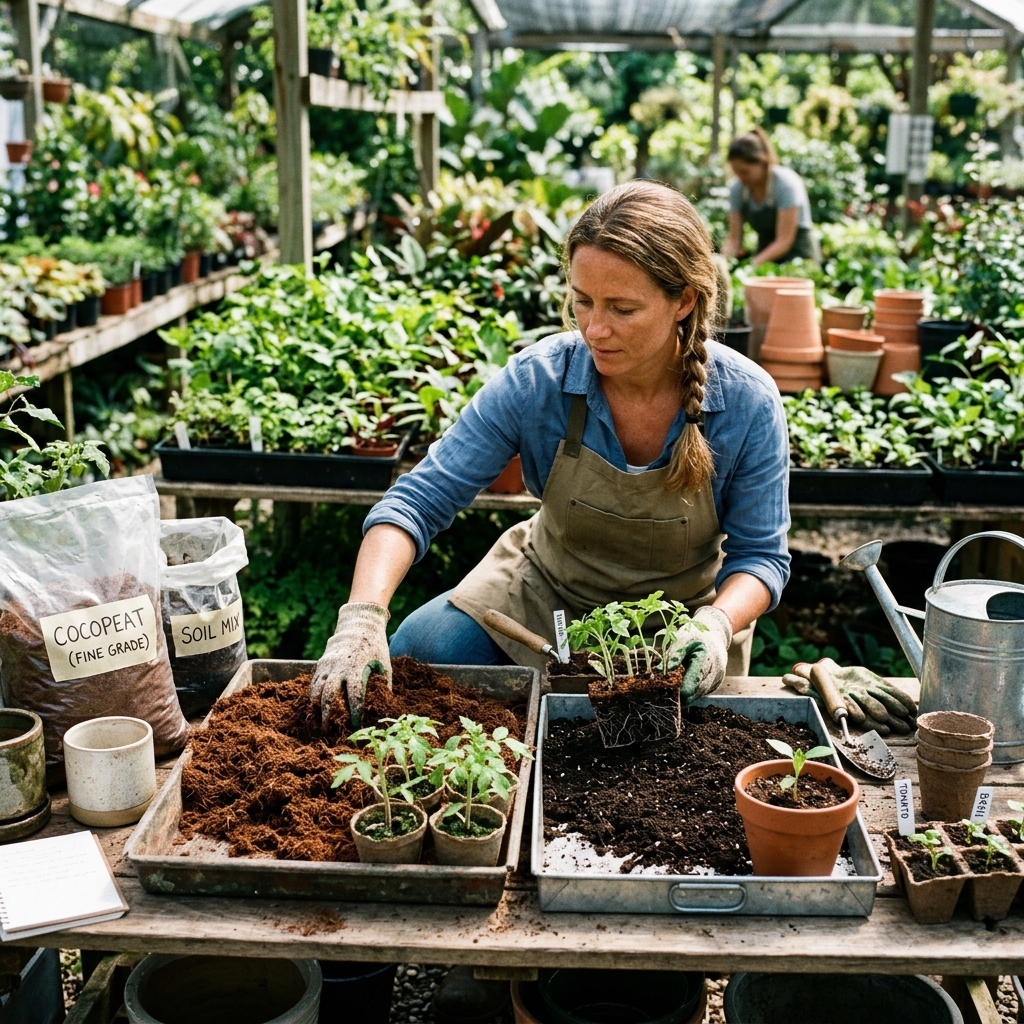
جوز الهند has revolutionized modern gardening as a high-performance, eco-friendly growing medium for home gardeners and commercial agricultural operations alike. Extracted from processed coconut husks, this natural byproduct delivers extraordinary water retention, root oxygenation, and structural longevity for indoor and outdoor plants.
Finding the optimal soilless potting mix can feel daunting given the overwhelming choices of topsoils, composts, and synthetic substrates. In this comprehensive guide, you will discover the scientific principles behind coconut coir pith, compare cocopeat vs topsoil for gardening, and learn how to mix customized substrates for vibrant crop yields in 2026.

What Is Cocopeat and How Is It Made?
جوز الهند—frequently referred to in professional horticulture as coco coir pith—is a 100% natural, biodegradable growing medium derived from the fibrous outer husk of coconuts (كوكوس نوسيفيرا). It functions as a resilient organic soil amendment or a complete soilless growing medium, holding up to ten times its dry weight in water while maintaining ideal pore space for aggressive root development.
During commercial processing, long coarse coir fibers are extracted for heavy-duty industrial applications such as rope weaving, door mats, and brush manufacturing. The remaining spongy cellular dust and micro-fibers are collected, thoroughly washed, heat-treated, dried, and compressed into dense bricks, briquettes, or bulk agricultural bales. As documented in Wikipedia’s detailed reference on coir processing, this sustainable methodology converts former agricultural waste into high-value horticultural substrates.
Modern nursery managers favor processed coconut coir pith because it offers a naturally sterile, pathogen-free environment devoid of weed seeds, parasitic nematodes, and soil-borne fungal spores. When hydrated with fresh water, compressed blocks expand rapidly up to six times their original dry volume, creating a fluffy, workable material that simplifies bulk storage and reduces international shipping costs.
Cocopeat vs. Traditional Topsoil: Key Differences Compared
Evaluating how raw coconut pith differs from native garden dirt is essential for mastering plant irrigation and fertilization schedules. Native garden topsoil easily compacts in container pots over time, suffocating fine feeder roots and causing severe waterlogging.
Conversely, coconut coir maintains its structural integrity over multi-year growing cycles. It resists compaction while facilitating continuous air circulation around the root zone. Below is a direct comparison showing how coir pith measures up against traditional garden dirt:
| Physical & Chemical Property | Cocopeat Substrate | Traditional Topsoil |
|---|---|---|
| Water Retention Capacity | Exceptional (Holds 8–10x dry weight) | Moderate to Low (Drains rapidly or pools) |
| Aeration & Porosity | High (Maintains 30% air space when saturated) | Low (Prone to heavy compaction) |
| Natural pH Range | Slightly Acidic to Neutral (5.8 – 6.8) | Highly Variable (5.0 – 8.5) |
| Native Nutrient Levels | Inert (Requires external fertilization) | Variable organic nutrients present |
| Pathogen & Weed Risk | Naturally sterile & disease-free | May harbour weed seeds & fungi |
| Substrate Reusability | Reusable for 3 to 5 plant cycles | Requires annual replacement/amendments |
While topsoil contains native organic matter, its tendency to compact in pots restricts critical root oxygenation. Coconut coir functions like a micro-sponge, retaining moisture uniformly while keeping the soilless potting mix light and airy. Beyond horticultural growing media, agricultural operations frequently combine plant-based co-products like معصرة نواة النخيل and nutrient-dense وجبة جوز الهند into commercial feeds to optimize livestock nutrition alongside sustainable crop setups.

Top 7 Essential Benefits of Using Cocopeat for Plants
Integrating organic coconut coir into your horticultural routines delivers immediate vegetative benefits. Sustainable environmental guidelines established by the Royal Horticultural Society peat-free initiative strongly advocate for renewable substrate alternatives, establishing coir as an industry-leading peat moss alternative. Below are the 7 primary advantages:
- احتفاظ فائق بالماء: Coconut pith captures liquid inside microscopic cellular pores, reducing container watering requirements by up to 30% compared to standard peat or soil mixes.
- Prevents Root Rot via High Aeration: Even when fully saturated with water, coir retains roughly 30% air porosity, ensuring roots continuously absorb oxygen without risk of fungal decay.
- Naturally Antibacterial and Antifungal: Natural lignin compounds within coir fibers actively inhibit Pythium, Rhizoctonia, and other damping-off root pathogens naturally.
- Optimal Neutral pH Range: Operating naturally between pH 5.8 and 6.8, coir allows plants to absorb macro and micronutrients efficiently without needing heavy lime amendments.
- Eco-Friendly Peat Moss Alternative: Harvesting peat moss destroys fragile wetland ecosystems and releases stored carbon. Coir repurposes agricultural waste from established coconut harvests without ecological damage.
- Long-Lasting Structural Durability: High cellular lignin content resists microbial decomposition, allowing growers to re-sanitize and reuse coir mixes for up to five consecutive growing seasons.
- Lightweight Container Gardening: Reduced medium weight protects balcony railings, vertical green walls, and rooftop garden structures from excessive structural loads.
Additionally, agricultural research conducted by the University of Florida IFAS Extension confirms that properly buffered coir media exhibit excellent cation exchange capacity (CEC), allowing target plants to utilize essential calcium, magnesium, and potassium ions effectively.
How to Prepare and Use Cocopeat Blocks Properly
Commercial coconut coir usually arrives compressed into high-density blocks to reduce transport volume. Learning how to prepare cocopeat blocks correctly ensures your plants experience optimal moisture distribution and root expansion from the moment they are potted.
Step-by-Step Guide: How to Prepare Cocopeat Blocks
Expanding compressed coir bricks into usable growing media requires simple, systematic steps:
- Step 1: Bucket Setup: Place your dry block inside a large basin or container capable of holding at least five to six times the brick’s dry volume.
- Step 2: Add Warm Water: Pour approximately 4 to 5 liters of warm water per 1kg coir brick directly over the block. Warm water breaks down binding waxes faster than cold water.
- Step 3: Soaking Period: Allow the brick to absorb water for 15 to 20 minutes. The compressed block will expand dramatically as it hydrates.
- Step 4: Fluff the Material: Break up any remaining dense core chunks using a hand trowel or your hands until the substrate achieves a uniform, airy texture.
- Step 5: Flush & Drain (If Unwashed): If utilizing unwashed agricultural coir, flush thoroughly with clean water to rinse out excess background salts before potting sensitive seedlings.
Buffering Cocopeat with Calcium and Magnesium
Raw coconut coir naturally contains sodium and potassium ions bound to its cation exchange sites. If unbuffered, coir absorbs added calcium and magnesium from your fertilizer while releasing excess sodium to your plant’s roots, leading to calcium deficiencies (such as blossom end rot in tomatoes).
To buffer your coir effectively, soak hydrated coir in a dedicated Calcium-Magnesium (Cal-Mag) solution (diluted at 3–5ml per gallon of water) for 24 hours. The calcium and magnesium cations replace the sodium ions on the coir exchange sites, preventing nutrient lockup during active vegetative growth.
Recommended Cocopeat Mix Recipes for Container Gardening
Because coir is an inert growing medium devoid of native fertilizers, combining it with organic compost or structural amendments is critical. Try these tested substrate recipes:
- All-Purpose Houseplant Substrate: Combine 40% جوز الهند, 40% organic leaf compost, and 20% horticultural perlite for ideal moisture and aeration.
- Succulent & Cactus Blend: Mix 30% coir pith, 20% compost, and 50% coarse pumice or coarse sand to promote rapid drainage and dry-down cycles.
- Seed Germination Mix: Combine 80% finely sifted coir pith with 20% fine vermiculite. Begin feeding a mild liquid organic fertilizer once true leaves sprout.
Potential Drawbacks of Cocopeat and Common Mistakes to Avoid
Although coconut coir offers extraordinary benefits for indoor and outdoor plants, improper management can lead to cultivation issues. Recognizing these potential drawbacks ensures long-term success across all your gardening setups.

Salt Toxicity and High Electrical Conductivity (EC)
Low-grade or unwashed coir harvested near ocean coastlines frequently contains elevated levels of residual sodium chloride. High salt concentrations scorch delicate root tips and cause foliage burn. Sourcing certified triple-washed or buffered coir guarantees low electrical conductivity (EC below 0.5 mS/cm).
Cation Exchange and Nutrient Lockup Issues
As noted, unbuffered coir naturally binds free calcium and magnesium while releasing potassium. Failing to supply extra Cal-Mag during early growth stages often results in interveinal chlorosis and weak stems in heavy-feeding crops like peppers, cannabis, and tomatoes.
Over-Watering and Over-Fertilization Pitfalls
Because coir retains moisture exceptionally well, growers accustomed to quick-drying topsoil may accidentally overwater. Furthermore, since pure coir contains no natural nutrients, failing to provide liquid plant food or mixed compost will quickly cause nitrogen starvation and pale, yellowing leaves.
In addition to horticultural substrates, agro-industrial producers leverage diverse plant derivatives to optimize soil stability and biomass efficiency. For example, hard renewable materials like قشرة نواة النخيل are frequently utilized in industrial boiler fuel applications, while specialized oil derivatives like RBD CP8 and energy-dense additives like أملاح الكالسيوم للأحماض الدهنية لزيت النخيل support large-scale agricultural and livestock infrastructure worldwide.
Is Cocopeat Right for Your Specific Plant Types?
Most plant species thrive in coir-enriched media, but matching your potting mix to specific crop requirements delivers the highest yields across indoor, outdoor, and hydroponic systems.
Indoor Houseplants: Is cocopeat good for indoor plants? Absolutely. Tropical foliage plants like Monsteras, Pothos, Philodendrons, and Ferns benefit immensely from coir’s resistance to soil compaction in indoor pots. It maintains steady root moisture while preventing stagnant soil condition.
Vegetable Patch & Raised Beds: Incorporating processed coir into heavy clay soil breaks up dense clods and improves drainage. In sandy garden beds, coir acts as a water-holding buffer, preserving soil moisture during hot summer droughts.
Seed Germination & Hydroponic Systems: The uniform, fine structure of sifted coir allows delicate seedling roots to penetrate without resistance. Published peer-reviewed research in ScienceDirect coir studies and formal growing guidelines from the Food and Agriculture Organization (FAO) reports confirm that high-porosity coir media consistently outperform raw soil in high-yield commercial hydroponic strawberry and tomato cultivation.
الأسئلة الشائعة حول جوز الهند
Is cocopeat better than regular soil for houseplants?
Yes, for indoor container plants, coir is superior to regular topsoil. It resists compaction, retains moisture evenly, provides up to 30% air space for roots, and is completely sterile, significantly reducing the risk of soil-borne pests, root rot, and indoor fungus gnats.
Does cocopeat contain natural nutrients for plants?
No, pure coir is an inert growing medium containing virtually no essential macro or micronutrients. To support healthy growth, you must mix it with nutrient-rich compost or supply balanced water-soluble fertilizers regularly throughout the plant’s growing cycle.
How often should you water plants growing in cocopeat?
Water your plants when the top inch of the coir substrate feels dry to the touch. Because coir holds up to ten times its dry weight in water, irrigation frequency is typically 20% to 30% less frequent compared to standard topsoil mixes.
Can I use 100% cocopeat to grow plants?
Seeds can germinate in 100% pure coir, but long-term growth requires added nutrition. For mature plants, coir is best used mixed with compost (30–50%) and drainage amendments like perlite, or utilized as a soilless medium in hydroponic setups with liquid fertilizer.
How long does cocopeat last before replacing?
Coir breaks down very slowly due to its high natural lignin content. In potted container mixes or raised garden beds, high-grade coir typically maintains its beneficial structural integrity for 3 to 5 years before requiring replacement or fresh soil amendments.

خاتمة
Integrating high-grade جوز الهند into your container mixes or garden beds delivers a sustainable, highly productive foundation for growing vibrant, healthy plants. By balancing exceptional water retention with superior root oxygenation, this coconut coir derivative prevents root rot and optimizes nutrient uptake.
Whether you are sprouting microgreens indoors or mixing potting substrates for tropical houseplants, utilizing washed and buffered coir yields stronger root networks and thriving crops. Combine your coir with quality organic compost and balanced fertilizers to watch your garden flourish in 2026. Explore our premium bulk cocopeat products today to elevate your agricultural and horticultural performance!
 Arabic
  English
  Indonesian
  Chinese