جدول المحتويات
Navigating the world of edible oils can be complex, especially when faced with technical terms and grades. If you’re a buyer, distributor, or food manufacturer, understanding the nuances in the RBD Palm Olein CP6 vs. CP8 vs. CP10 debate is crucial for making informed purchasing decisions. Each grade serves a distinct purpose, and choosing the wrong one can impact your product quality and bottom line.
This comprehensive guide to RBD Palm Olein CP6 vs. CP8 vs. CP10 breaks down everything you need to know about these three popular grades. We’ll explore their key differences, ideal applications, and how to select the perfect grade for your specific needs, ensuring you invest in the right product every time.

ما هو RBD Palm Olein؟
Before diving into the comparison, let’s quickly define RBD Palm Olein. The term “RBD” stands for مكرر ومبيض ومزال الرائحة (Refined, Bleached, and Deodorized). This refers to the purification process that زيت النخيل الخام (CPO) undergoes to become a stable, odorless, and neutral-tasting cooking oil. The entire process starts with harvesting the عناقيد ثمار نخيل الزيت, from which the oil is extracted.
Palm oil is unique because it’s semi-solid at room temperature. To create a liquid cooking oil (olein), it goes through fractionation. This process separates the liquid part (olein) from the solid part (stearin). The resulting RBD Palm Olein is one of the world’s most widely used cooking oils, while the fruit’s nut, the نواة النخيل, is also processed to create other valuable products.
The Core Difference in RBD Palm Olein CP6 vs. CP8 vs. CP10: Cloud Point (CP)
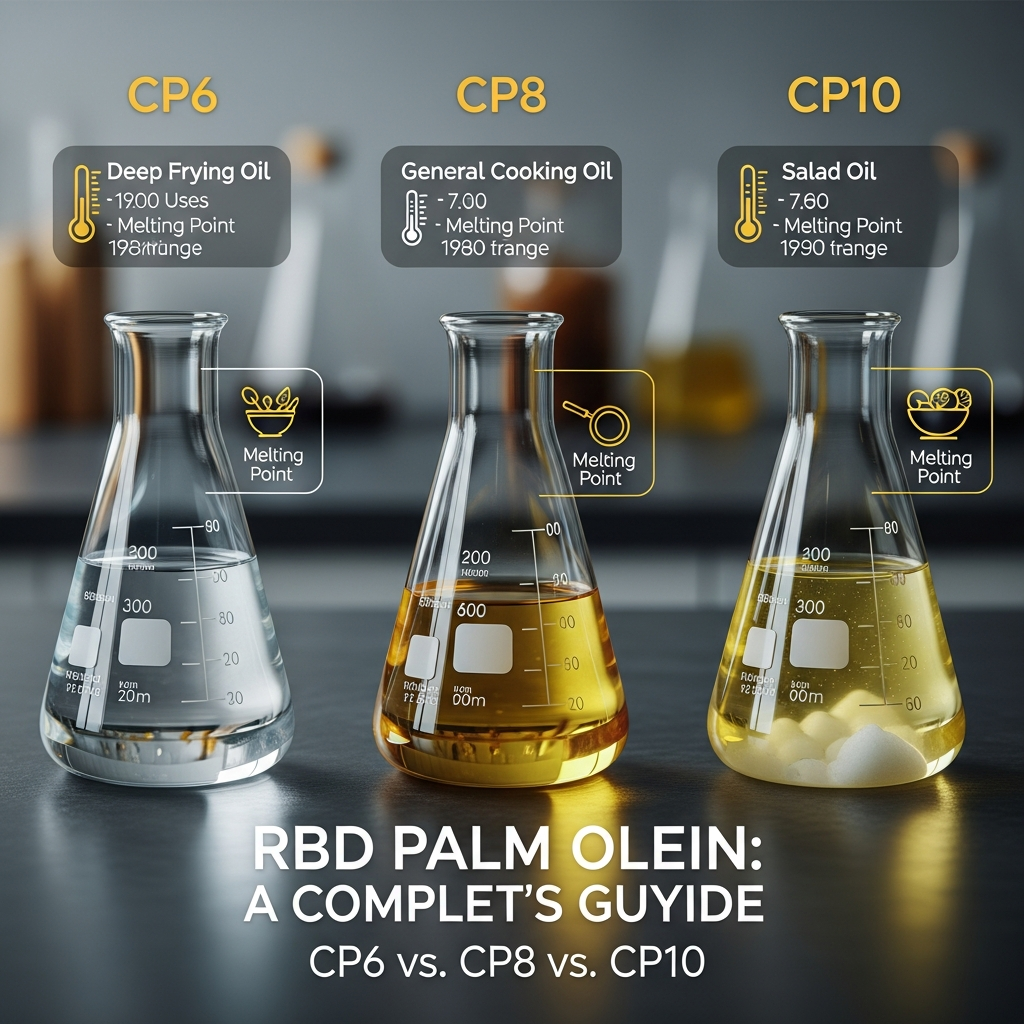
The single most important factor in the RBD Palm Olein CP6 vs. CP8 vs. CP10 discussion is the نقطة العتامة (CP). This metric is the temperature at which the oil starts to become cloudy or solidify when cooled. The number after “CP” indicates the maximum cloud point in degrees Celsius.
- CP6: Cloud Point of 6°C (max)
- CP8: Cloud Point of 8°C (max)
- CP10: Cloud Point of 10°C (max)
A lower cloud point means the oil will remain liquid at lower temperatures. This is a critical property for products sold in colder climates or those that require refrigeration. The difference in cloud point is achieved through more intensive fractionation, which also affects the price.
Detailed Comparison: RBD Palm Olein CP6 vs. CP8 vs. CP10
While Cloud Point is the primary differentiator, other technical specifications also vary slightly. Understanding the complete picture of RBD Palm Olein CP6 vs. CP8 vs. CP10 helps in precise application matching.
| ميزة | RBD Palm Olein CP6 | RBD Palm Olein CP8 | RBD Palm Olein CP10 |
|---|---|---|---|
| نقطة التغبيش (Cloud Point) | 6°C Maximum | 8°C Maximum | 10°C Maximum |
| الملاءمة المناخية | Cold / Temperate | معتدل | استوائي / حار |
| قيمة اليود (IV) | 58 Minimum | 57 Minimum | 56 Minimum |
| السعر | الأعلى | متوسط | الأدنى |
Cloud Point and Climate Suitability
As the table shows, CP6 is the premium choice for colder regions like Europe and North America. Its ability to stay liquid at lower temperatures prevents cloudiness on store shelves. CP10 is perfectly suited for hot climates in Asia, Africa, and the Middle East where ambient temperatures keep it liquid year-round.
Free Fatty Acid (FFA) and Quality
Free Fatty Acid (FFA) content indicates an oil’s quality. For all RBD palm olein grades, the FFA is very low (typically below 0.1%). While there’s no significant difference in the FFA of CP6 vs. CP8 vs. CP10, buyers should always request a Certificate of Analysis (CoA) to ensure it meets international standards, like those set by the Codex Alimentarius Commission.
Iodine Value (IV) and Stability
Iodine Value (IV) measures the degree of unsaturation. A higher IV indicates more double bonds, correlating to a lower melting point. This is why CP6 has a slightly higher minimum IV than CP10. While this makes it more liquid, it can also slightly reduce its oxidative stability, although all grades are highly stable for frying. For more on this topic, the American Oil Chemists’ Society (AOCS) provides in-depth resources.
Price and Market Availability
The fractionation required to achieve a lower cloud point is more intensive. This means more processing is needed to produce CP6, making it the most expensive of the three. CP10 is the most widely traded grade, making it the most cost-effective and readily available option.
Application Guide: Which Grade is Right for You?
The ultimate decision in the RBD Palm Olein CP6 vs. CP8 vs. CP10 choice comes down to your final product and target market.
When to Choose RBD Palm Olein CP6
CP6 is the premium grade for applications where maintaining a clear liquid form at cooler temperatures is essential.
- Salad Dressings & Mayonnaise: Prevents solidification when refrigerated.
- Premium Liquid Cooking Oil: For bottling and retail sale in temperate or cold countries.
- Pharmaceuticals & Cosmetics: Where consistency at various temperatures is key.
When to Choose RBD Palm Olein CP8
CP8 is a versatile option, offering better cold stability than CP10 without the premium price of CP6.
- General Frying: A great all-purpose frying oil for restaurants in moderate climates.
- التصنيع الغذائي: Suitable for products sold in regions with distinct seasons.
When to Choose RBD Palm Olein CP10
CP10 is the global workhorse and the most economical choice for high-volume applications, especially in warm climates.
- القلي الصناعي: The standard for large-scale production of snacks, instant noodles, and fast food.
- الطهي العام: The most common cooking oil sold in tropical countries.
- Ingredient in Margarine/Shortening: Blended with other fats for various food products.
Sourcing and Quality Assurance for Buyers
When sourcing palm olein, partner with reliable suppliers who provide consistent quality and a range of products. A comprehensive supplier offers not only palm olein but also other essential palm derivatives. These include high-protein معصرة نواة النخيل for animal feed, eco-friendly قشرة نواة النخيل for biomass energy, and specialty زيت نواة النخيل for confectioneries. Always ask for a recent Certificate of Analysis (CoA) to verify specifications. Furthermore, look for certifications from the Roundtable on Sustainable Palm Oil (RSPO) to ensure your purchase supports responsible practices.
الخلاصة: اتخاذ القرار الصحيح
The debate over RBD Palm Olein CP6 vs. CP8 vs. CP10 is not about which oil is “better” overall, but which is best suited for a specific purpose. The key takeaway is to let your application and target climate guide your decision. CP6 offers superior cold stability for premium products in cool regions, CP10 provides unbeatable value for high-volume frying in warm climates, and CP8 serves as a flexible midpoint. By understanding the fundamental differences in the RBD Palm Olein CP6 vs. CP8 vs. CP10 spectrum, you can optimize your product quality and make smarter purchasing decisions in 2025 and beyond.
توفر Makmur Amanah Sejahtera منتجات نخيل عالية الجودة مثل Palm Kernel Expeller وPalm Kernel Shell وCrude Palm Oil وPalm Kernel Oil وغيرها. يرجى التواصل معنا عبر WhatsApp على الرقم +6282140002198 أو مراسلتنا عبر البريد الإلكتروني admin@makmuramanah.co.id.هل تبحث عن منتجات النخيل عالية الجودة؟