جدول المحتويات
- ما هي عذوق النخيل الفارغة (EFB)؟
- How is an Empty Palm Fruit Bunch Processed?
- The Top 5 Astonishing Uses of Empty Palm Fruit Bunch
- The Environmental and Economic Potential of Empty Palm Fruit Bunch
- Challenges and the Future Outlook for Empty Palm Fruit Bunch
- الخاتمة: من نفايات إلى ثروة
- الأسئلة الشائعة (FAQ)
In the vast world of agriculture, the palm oil industry is a giant. But with large-scale production comes a significant amount of biomass waste. For years, one of the most substantial byproducts was considered a nuisance. We’re talking about the عراجين ثمار النخيل الفارغة (EFB), the fibrous material left behind after the valuable fruitlets are stripped away. But what if this “waste” is actually a valuable resource waiting to be harnessed?
This guide will explore the incredible journey of the عراجين ثمار النخيل الفارغة from a disposal headache to a cornerstone of the circular economy. We’ll dive deep into what it is, how it’s processed, and its revolutionary applications that are changing industries and paving the way for a more sustainable future.
ما هي عذوق النخيل الفارغة (EFB)؟
إن عراجين ثمار النخيل الفارغة (EFB) is the lignocellulosic biomass that remains after the palm fruits have been removed from the عناقيد ثمار نخيل الزيت (FFB) during the milling process, which produces essentials like زيت النخيل الخام و زيت نواة النخيل. Think of it as the stalk or skeleton of the fruit cluster. Each ton of processed fresh fruit bunches can generate approximately 220-230 kg of EFB, making it one of the most abundant waste products in the palm oil sector.
Initially, this raw عراجين ثمار النخيل الفارغة has a very high moisture content, often between 60-70%, which makes it heavy and difficult to handle. Its composition is primarily a complex matrix of lignocellulosic materials: cellulose, hemicellulose, and lignin. These are the same core components that make up wood, which hints at the incredible versatility and potential locked within EFB.

How is an Empty Palm Fruit Bunch Processed?
Before an عراجين ثمار النخيل الفارغة can be used effectively, it needs to undergo several processing steps to reduce its moisture content and break it down into a more manageable form. The specific process depends on its intended final use, but the core stages are generally similar.
First, the raw EFB is often put through a shredder or crusher. This machine tears the large, bulky bunches into smaller, more uniform pieces, increasing the surface area. Following this, the shredded material is sent to a pressing machine to squeeze out a significant amount of water. This single step can drastically reduce its weight and volume, making transportation far more economical.
For applications requiring very low moisture, like biofuel pellets, the pressed عراجين ثمار النخيل الفارغة fibers are then dried further in a rotary dryer. The final product can be sold as long fiber, short fiber, or further compressed into high-density pellets or briquettes for easy storage and combustion.
The Top 5 Astonishing Uses of Empty Palm Fruit Bunch
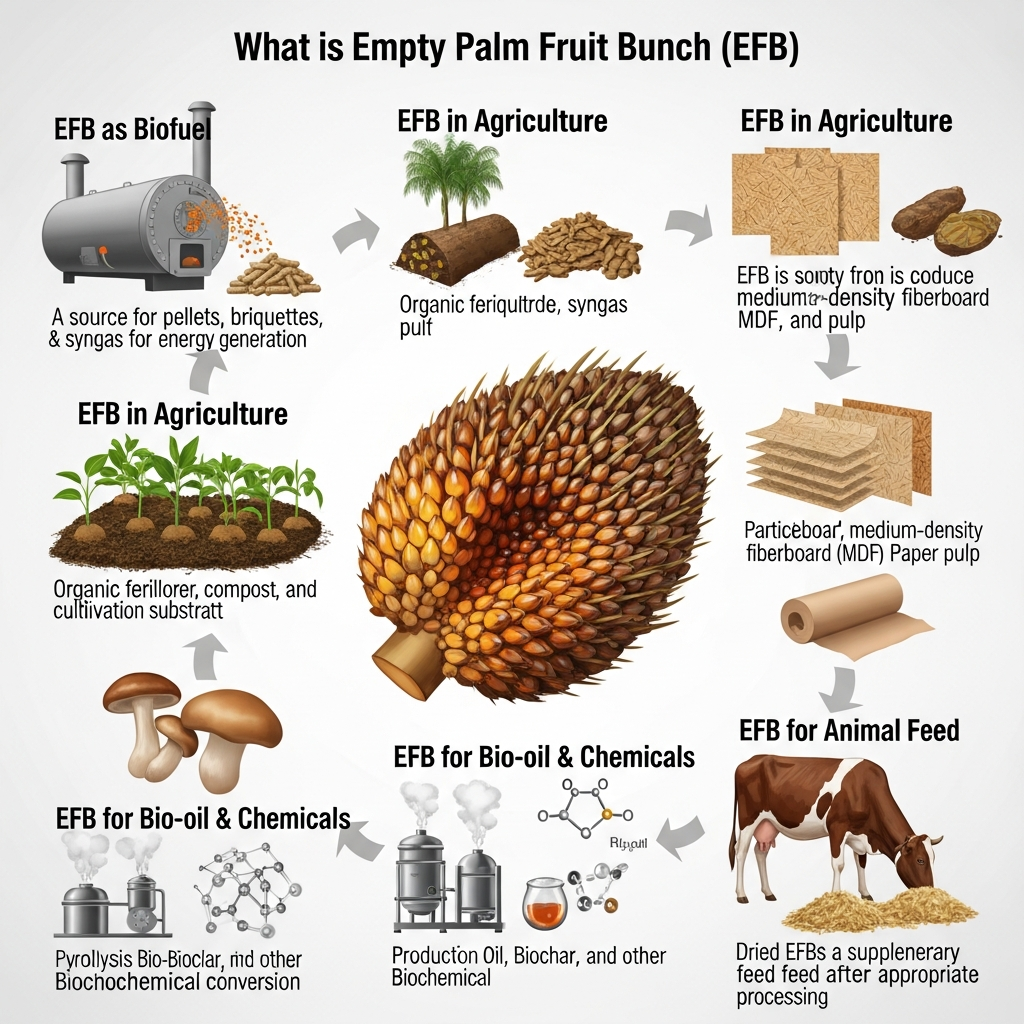
The true magic of the عراجين ثمار النخيل الفارغة lies in its versatility. What was once left to rot in fields is now being transformed into a range of valuable products across different sectors. Here are five of its most significant uses.
1. توليد الوقود الحيوي والطاقة المتجددة
Perhaps the most widespread use of EFB is as a solid biofuel. Its high energy content makes it an excellent substitute for fossil fuels like coal. Palm oil mills often use shredded EFB in their own boilers to generate steam and electricity, creating a self-sustaining energy loop. On a larger scale, dried and pelletized EFB is exported globally and used in power plants for co-firing. It joins other valuable biomass products like معصرة نواة النخيل و قشرة نواة النخيل as a key player in reducing carbon emissions, a goal supported by agencies like IRENA.
2. High-Quality Compost and Mulch
Due to its organic nature, an unprocessed عراجين ثمار النخيل الفارغة makes for fantastic compost. When left to decompose, it turns into a dark, nutrient-rich organic fertilizer. This EFB compost is excellent for improving soil structure, increasing water retention, and replenishing nutrients in plantations. Using it as mulch also helps suppress weed growth and prevent soil erosion, contributing to more sustainable agriculture practices.

3. إنتاج مستدام للورق وعجينة الورق
The high cellulose fiber content in an عراجين ثمار النخيل الفارغة makes it a viable alternative raw material for the pulp and paper industry. By using EFB fiber, manufacturers can reduce their reliance on wood from forests, helping to combat deforestation. The paper produced from EFB is of high quality and is suitable for printing and writing, as well as for packaging materials like cardboard.
4. Eco-Friendly Fibreboard and Building Materials
EFB fibers can be mixed with a binding agent and compressed under high pressure and temperature to create medium-density fibreboard (MDF), particleboard, and other composite materials. These boards are used extensively in furniture manufacturing and interior construction. This application of the عراجين ثمار النخيل الفارغة provides a sustainable building material and reduces waste from both the palm oil and construction industries.
5. Advanced and Innovative Materials
The potential of the عراجين ثمار النخيل الفارغة is still being unlocked. Researchers are actively exploring its use in creating high-value, advanced materials. This includes the production of bioplastics, which are biodegradable alternatives to petroleum-based plastics. Furthermore, EFB can be processed into activated carbon for filtration systems or even used as a precursor for creating nanomaterials and composites, as highlighted in various scientific journals on polymers.
The Environmental and Economic Potential of Empty Palm Fruit Bunch
Harnessing the power of the عراجين ثمار النخيل الفارغة offers a dual benefit. Environmentally, it transforms a massive waste stream into a valuable resource, preventing methane emissions from decomposition and reducing the need for fossil fuels. As highlighted by the EPA, composting organic waste like EFB enriches soil and reduces the need for chemical fertilizers.
Economically, it creates new revenue streams for palm oil producers, reduces their operational costs by providing an in-house energy source, and fosters job creation. This circular economy approach makes the entire industry more resilient and sustainable.
Challenges and the Future Outlook for Empty Palm Fruit Bunch
Despite its immense potential, utilizing the عراجين ثمار النخيل الفارغة is not without challenges. Its high initial moisture content makes it heavy and costly to transport, and the required processing technology demands significant capital investment. Establishing efficient supply chains from remote mills to industrial centers remains a logistical hurdle.
However, the future is bright. As technology improves and the global demand for sustainable solutions grows, the economics of EFB processing will become increasingly favorable. Ongoing research is focused on more efficient conversion technologies, positioning the عراجين ثمار النخيل الفارغة as a key player in the future of bio-based economies.
الخاتمة: من نفايات إلى ثروة
From waste to wealth, the journey of the عراجين ثمار النخيل الفارغة is a powerful testament to innovation in sustainability. By embracing this abundant resource, we can reduce environmental impact, create economic value, and move closer to a truly circular economy. The potential is vast, and its role in a greener future is undeniable.
الأسئلة الشائعة (FAQ)
What is the difference between EFB and palm kernel shells?
Both are biomass from the palm oil industry. The Empty Palm Fruit Bunch is the fibrous stalk of the fruit cluster, while palm kernel shells are the hard, woody shell surrounding the نواة النخيل. Both are used as biofuel, but they have different properties and handling requirements.
Is using Empty Palm Fruit Bunch sustainable?
Yes, its use is considered highly sustainable. It is a byproduct of an existing industry, so it does not require additional land for cultivation. Utilizing the عراجين ثمار النخيل الفارغة reduces waste, displaces fossil fuels, and promotes a circular economy, all of which are key principles of sustainability.
How much energy is in an Empty Palm Fruit Bunch?
The calorific value of an عراجين ثمار النخيل الفارغة depends on its moisture content. Once processed into dried fiber or pellets (with ~10% moisture), it typically has a calorific value of around 15-17 MJ/kg, making it a potent source of renewable energy.
هل تبحث عن منتجات النخيل عالية الجودة؟
توفر Makmur Amanah Sejahtera منتجات نخيل عالية الجودة مثل Palm Kernel Expeller وPalm Kernel Shell وCrude Palm Oil وPalm Kernel Oil وغيرها. يرجى التواصل معنا عبر WhatsApp على الرقم +6282140002198 أو مراسلتنا عبر البريد الإلكتروني admin@makmuramanah.co.id.