
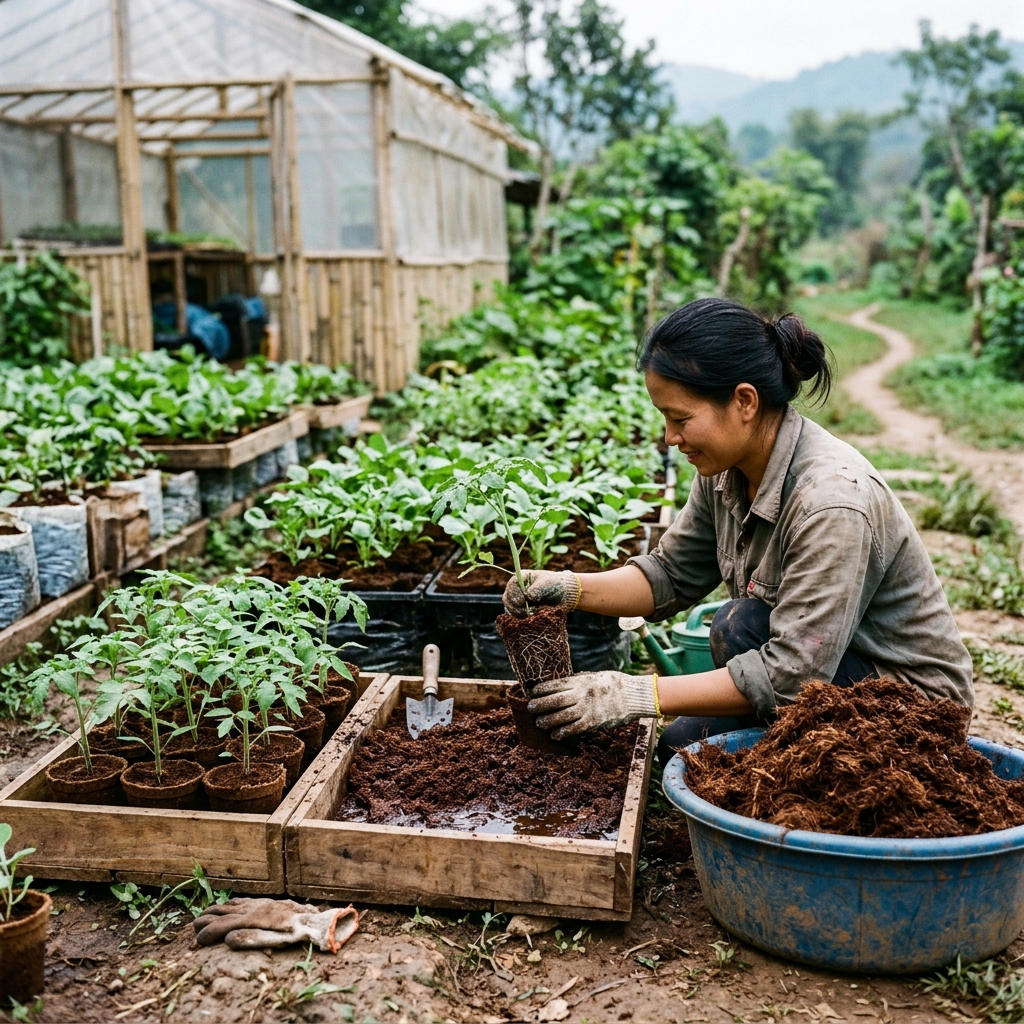
جوز الهند is an exceptional growing medium that has revolutionized modern horticulture by solving the dual challenge of moisture retention and root oxygenation. Gardeners and commercial greenhouse operators frequently battle dense soil that chokes fragile roots or sandy substrates that leach nutrients instantly. Understanding how this organic coir substrate operates allows growers to achieve vigorous root architecture and substantially higher crop yields.
According to agricultural analyses by the منظمة الأغذية والزراعة (الفاو), utilizing coconut processing by-products transforms potential agricultural waste into high-value, sustainable horticultural solutions. By transitioning from depleted soil to renewable coconut coir, growers minimize ecological strain while maximizing water use efficiency. In this comprehensive manual, you will learn the physical properties, essential buffering chemistry, and practical applications of this soilless growing medium.
What Is Cocopeat? Composition and Horticultural Origin
جوز الهند, commonly known in commercial horticulture as coir pith or coconut dust, is the natural cellular binding material derived from the mesocarp of the coconut (كوكوس نوسيفيرا). During the extraction of long coir fibers for industrial ropes, mats, and brushes, processors collect the remaining granular micro-sponges. These organic particles function as an exceptionally durable, lightweight potting mix substrate.
تعريف: Cocopeat is a spongy, 100% organic growing medium manufactured from processed coconut husk dust. It acts as a lightweight, peat-free soil conditioner and hydroponic substrate that retains 8 to 10 times its dry weight in water while maintaining 20% to 30% air-filled porosity for optimal root zone health.
Unlike native garden soil, raw coir pith maintains an extraordinarily resilient cellular matrix. Furthermore, horticulturists value this material because its natural lignins degrade far slower than traditional peat moss, preserving structural macro-pores within nursery containers over multiple production cycles.
How Coir Pith Is Processed for Plant Cultivation
Raw coconut husks absorb significant quantities of sodium and potassium chloride from tropical coastal soils. Consequently, responsible processing facilities submerge raw coir in clean freshwater settling basins over multiple months. This leaching phase washes away excess mineral salts until the Electrical Conductivity (EC) drops below 0.5 mS/cm.
Following thorough desalinization, manufacturers grade the coir particles, sun-dry them to approximately 15% moisture content, and compact the material under hydraulic presses. This industrial manufacturing process creates solid, lightweight briquettes and blocks designed for easy transport and rapid rehydration.
7 Powerful Benefits of Cocopeat for Plant Growth
Modern commercial horticulturists continue shifting toward coir-based cultivation because it delivers measurable biological advantages over traditional garden substrates. Below are seven verified advantages that make coir pith an indispensable tool for hobbyists and commercial growers alike.
1. Unmatched Water Retention Capability
Cocopeat can absorb and hold 8 to 10 times its own dry weight in water. Microscopic capillary tubes inside each pith particle draw in water rapidly, redistributing hydration evenly across the container without causing waterlogging or anaerobic dead zones.
2. Superior Air-Filled Porosity and Root Aeration
While standard peat often compacts after repeated irrigations, coir maintains an air porosity of 20% to 30% even at full water saturation. As documented by studies published via University of Florida IFAS Extension, adequate pore volume prevents root rot diseases caused by بيثيوم و فيتوفثورا.
3. Naturally Favorable and Stable pH Range
Sphagnum peat moss is naturally acidic with a pH of 3.5 to 4.5, requiring growers to apply agricultural lime to prevent nutrient lockout. In contrast, quality coir boasts an ideal natural pH between 5.8 and 6.8, accommodating the nutrient uptake requirements of almost all ornamental and edible plants.
4. Renewable, Peat-Free Environmental Sustainability
Peat bogs represent critical global carbon sinks that require millennia to regenerate after commercial strip-mining. Leading conservation entities like the الجمعية الملكية للبستنة (RHS) strongly encourage transitions to renewable, peat-free alternatives to mitigate carbon emissions and protect fragile wetland ecosystems.
5. High Cation Exchange Capacity (CEC)
The cation exchange capacity of coir ranges between 40 and 100 meq/100g. This molecular property allows the substrate to hold dissolved nutrients—such as magnesium, calcium, and potassium—and release them directly to feeder roots on demand rather than washing away during irrigation cycles.
6. Exceptional Durability and Slow Lignin Decomposition
Cocopeat contains high concentrations of natural lignins and cellulose that resist enzymatic breakdown by soil microbes. Consequently, your potting medium resists settling, compaction, and souring, meaning you can steam, solarize, and reuse it for up to four consecutive seasons.
7. Pathogen Resistance and Clean Germination
Properly processed coir arrives naturally free of weed seeds, parasitic nematodes, and pathogenic bacteria. The substrate also carries trace levels of natural التريكوديرما fungi, a beneficial microbe family that parasitizes harmful fungal pathogens and defends emerging root tissues.
Cocopeat vs Peat Moss: A Comprehensive Technical Comparison
Horticultural professionals frequently debate whether to choose traditional peat moss or coconut coir for commercial container operations. The following comparison table highlights their structural, environmental, and chemical differences.
| Horticultural Parameter | Cocopeat (Coir Pith) | طحلب الخث السفاجنوم |
|---|---|---|
| Natural pH Level | 5.8 – 6.8 (Near-neutral, self-buffering) | 3.5 – 4.5 (Highly acidic, requires lime) |
| Water Rehydration | Instantaneous; readily absorbs moisture when bone-dry | Hydrophobic; repels water when dry, needs wetting agents |
| Ecological Impact | 100% renewable agricultural co-product | Mined from slowly regenerating wetland bogs |
| Air-Filled Porosity | High (20% – 30%), resists structural compaction | Moderate initially, degrades and compacts over time |
| Potassium Content | Naturally rich; requires calcium-magnesium buffering | Very low; nutrient-sterile baseline |
While peat moss has historic loyalty in commercial greenhouses, industrial substrate research from امتداد جامعة ولاية بنسلفانيا confirms that coir matches or surpasses peat in both seed viability and finished biomass across broad crop categories.
How to Use Cocopeat for Plants: Step-by-Step Preparation
Working with compressed coir blocks requires proper hydration and conditioning before potting your specimens. Skipping the preparation protocol can cause initial nutrient lockout that stunts juvenile seedlings.
- Rehydrate the Compressed Brick: Place a 5 kg block into a large clean trough or wheelbarrow. Gradually pour 25 to 30 liters of warm water over the block and let it soak for 15 minutes as it expands to 60–75 liters of fluffy substrate.
- Check and Rinse Residual Salinity: Although premium products come pre-rinsed, flush the expanding fibers with fresh water. Measure runoff with an EC meter; if the electrical reading exceeds 0.8 mS/cm, rinse once more to protect sensitive roots.
- Buffer the Cation Exchange Sites: Soak the damp fibers in a concentrated calcium-magnesium nitrate solution for 12 to 24 hours to displace loose sodium ions.
- Drain Excess Moisture: Squeeze the substrate until it maintains damp-sponge moisture without dripping freely between your fingers.
How to Buffer Cocopeat with Cal-Mag Solutions
The cation exchange complex in raw coir naturally saturates with potassium and sodium. If you plant directly into unbuffered medium, the cation sites will lock onto applied calcium and magnesium while releasing excess potassium into the rhizosphere.
To master how to buffer cocopeat with cal-mag, dissolve 15 to 20 grams of calcium nitrate and magnesium sulfate per 10 liters of hydration water. This chemistry displaces weak sodium bonds and loads the exchange sites with bioavailable calcium, eliminating blossom end rot in tomatoes and tip-burn in leafy greens.
Best Cocopeat Potting Soil Mix Ratio Guidelines
Pure coir holds extraordinary moisture, which can prove excessive for desert succulents or poorly ventilated indoor grow rooms. Formulate balanced potting recipes by blending the prepared substrate with targeted amendments:
- Standard Container Blend: 50% prepared coir, 30% aerating perlite or pumice, and 20% organic compost or worm castings.
- Moisture-Loving Aroids: 40% coir pith, 30% chunky coco chips, 20% perlite, and 10% horticultural charcoal.
- Seedling Germination Mix: 70% finely screened coir pith combined with 30% fine horticultural vermiculite.
For large-scale agricultural operations integrating agricultural by-products into livestock or field routines, sourcing high-grade materials remains critical. Explore export-grade جوز الهند alongside nutritious animal feedstocks like جوز الهند to optimize agricultural supply chains efficiently.
Top Horticultural Applications and Modern Uses
Commercial greenhouses and home growers utilize this versatile soilless medium across a wide variety of horticultural sectors:
- Hydroponic Run-to-Waste Systems: Coir slabs serve as the primary root anchor for commercial Dutch-bucket tomatoes, cucumbers, and strawberries worldwide.
- Seed Germination and Microgreens: The loose, fine-milled texture allows delicate juvenile taproots to push through easily without meeting stone obstructions.
- Clay Soil Conditioning: Tilling coarse coir into dense clay garden beds permanently fractures hardpan strata, elevating drainage and microbial vitality.
- Sandy Soil Remediation: Blending coir into loose sandy ground establishes moisture reservoirs that prevent fertilizers from leaching into groundwater tables.
Sustainable plantation systems rely on holistic resource management. Beyond substrate management, industrial agro-enterprises utilize supplemental bio-byproducts such as قشرة نواة النخيل for green biomass boiler energy, creating closed-loop efficiency across tropical processing facilities.
مكمور أمانة سجيتيرا توفر منتجات زيت النخيل عالية الجودة مثل معصرة نواة النخيل, قشرة نواة النخيل, Crude Palm Oil, Palm Kernel Oil, etc. Kindly contact us at WhatsApp +6282140002198 أو راسلنا عبر البريد الإلكتروني على admin@makmuramanah.co.id.
الأسئلة الشائعة حول جوز الهند
Does cocopeat contain natural plant nutrients?
No, cocopeat contains minimal baseline macro-nutrients apart from potassium and trace sodium. Because it acts primarily as an inert physical medium, you must supply complete water-soluble fertilizers or mix in organic amendments to feed growing plants throughout the season.
Can you grow plants in 100% pure cocopeat?
Yes, plants can thrive in pure cocopeat provided you supply a hydroponic nutrient solution containing balanced calcium and magnesium with every watering. However, adding 20% to 30% perlite prevents excess water saturation in low-light environments.
How long does cocopeat last before degrading?
Cocopeat contains high levels of durable lignin that resist biological breakdown. Under normal greenhouse or garden conditions, it maintains structural integrity for three to five years, allowing growers to pasteurize and reuse it across multiple successive harvest cycles.
Why must you buffer cocopeat with Cal-Mag?
Raw coir features naturally active cation sites loaded with potassium and sodium. Buffering pre-saturates these chemical sites with calcium and magnesium, preventing the medium from stripping essential minerals away from your fertilizers and starving your crop.
Is cocopeat safe for organic vegetable gardening?
Yes, genuine washed cocopeat is an OMRI-listed, 100% organic, non-toxic substrate. It provides an ideal disease-free medium for germinating heirloom vegetable seeds, producing culinary herbs, and potting greenhouse food crops without synthetic additives.
Conclusion: Maximizing Garden Yields with Cocopeat
Transitioning to eco-friendly growing substrates no longer requires sacrificing crop productivity or root vitality. By understanding the unique cation dynamics, porosity advantages, and proper buffering protocols of coconut coir, both hobbyists and agricultural enterprises unlock rapid root proliferation and dependable harvests.
Embracing sustainably processed جوز الهند guarantees superior moisture retention while protecting our planet's fragile wetland biomes. Implement these buffering and potting techniques today to elevate your cultivation success, minimize unnecessary plant stress, and harvest healthier plants throughout 2026.

 Arabic
 English
 Indonesian
 Chinese
