
Cocopeat Guide: 7 Essential Benefits & Soil Comparison (2026)
Cocopeat has rapidly emerged as one of the most efficient, sustainable growing media in modern global agriculture.
As commercial growers and home gardeners shift toward eco-friendly cultivation, replacing conventional topsoil and depleted peat moss has become a top priority. Consequently, finding a high-performing soilless substrate that balances root aeration with high moisture retention is critical for long-term plant health.
Cocopeat, also known as coconut coir or coir pith, is a 100% natural, renewable growing medium derived from the fibrous outer husk of coconut shells. Renowned for holding up to eight times its weight in water, maintaining a naturally neutral pH (5.8–6.5), and providing outstanding root oxygenation, it serves as an extraordinary soil conditioner and standalone hydroponic substrate.

Understanding how to use cocopeat for plant growth allows horticulturists to maximize crop yields while lowering irrigation costs across diverse climate zones.
What Is Cocopeat? Origin, Physical Properties, and Chemistry
To fully understand this versatile medium, one must examine its origin and structural parameters. Derived as a byproduct of the coconut husk fiber industry, coir pith consists of millions of microscopic, capillary-rich micro-sponges that absorb and hold liquid efficiently.
Historically, coir pith was treated as agricultural waste. Today, it stands as an elite horticultural input certified by international agricultural organizations like the FAO Soil Portal for sustainable land management and erosion control.
Chemically, raw coir pith contains substantial concentrations of naturally occurring lignin (over 45%) and cellulose. This high lignin content resists biological decomposition, allowing the physical pore structure to remain intact over several continuous cropping cycles without collapsing.
Furthermore, high-grade coir pith exhibits a favorable cation exchange capacity (CEC) ranging from 40 to 100 meq/100g. This property allows the substrate to retain crucial nutrient cations—such as calcium, magnesium, and potassium—and release them dynamically to root systems.
The Coconut Husk Fiber Extraction and Manufacturing Process
The transition from raw coconut husk fiber to premium agricultural coir involves precise mechanical separation. Husk husks are soaked in water to soften outer tissues, after which decorticating machines extract long coir fibers for ropes and matting.
The remaining spongy coir pith particles are screened, sieved, and graded by particle size. Fine particles are removed to eliminate fine dust, ensuring that the finished product maintains high air-filled porosity for commercial nursery applications.
Electrical Conductivity (EC) Testing and Calcium Nitrate Buffering
Commercial processing dictates final crop safety. Raw coconut coir pith harvested near coastal regions frequently contains high sodium and chloride ion concentrations. Therefore, reputable suppliers run thorough freshwater washing protocols to reduce Electrical Conductivity (EC) below 0.5 mS/cm.
Unbuffered coir naturally holds sodium and potassium on its exchange sites, which can displace added calcium and magnesium. During professional calcium nitrate buffering, sodium cations are washed away and replaced with calcium, preventing nutrient lockout.
Agricultural research indexed in ScienceDirect confirms that properly buffered coconut coir delivers superior root elongation and reduced leaf tip burn compared to unwashed alternatives.
7 Proven Benefits of Using Cocopeat in Modern Gardening

Integrating high-grade Cocopeat into your agricultural operation provides immediate biological and mechanical benefits. Here are seven verified advantages driving global commercial adoption:
- Unmatched Water Retention Capacity: Absorbs up to eight times its dry weight in water, storing moisture in uniform micro-capillaries for steady root hydration.
- Optimal Air Porosity: Maintains 15–20% air space even when fully saturated, drastically reducing risks of root hypoxia, damping off, and anaerobic rot.
- Naturally Neutral pH Profile: Exhibits a stable native pH of 5.8 to 6.5, eliminating the need for heavy lime additions typical with acidic peat media.
- Inherent Pathogen Suppression: Contains high natural tannin and lignin levels that create an inhospitable environment for harmful soil-borne pathogens like Pythium.
- Reusability and Structural Stability: Resists physical breakdown, allowing commercial growers to wash, steam-sterilize, and re-use the substrate for 3 to 5 years.
- 100% Sustainable Peat Moss Substitute: Harvested continuously from tropical palm crops without destroying carbon-rich wetland peat bog habitats.
- High Cation Exchange Capacity: Holds mineral nutrients efficiently, preventing chemical leaching during aggressive automated liquid fertigation routines.
Cocopeat vs. Traditional Soil & Peat Moss (Comparison)
Selecting the optimal substrate directly impacts plant performance. A detailed cocopeat vs peat moss comparison reveals key physical and ecological differences critical for commercial decisions, evaluated according to metrics documented by the UF/IFAS Extension.
| Physical Property | Cocopeat Substrate | Sphagnum Peat Moss | Standard Topsoil | Perlite Mix (30/70) |
|---|---|---|---|---|
| Water Retention Capacity | Exceptional (700–800%) | High (600–700%) | Moderate (20–40%) | Moderate (300–400%) |
| Air Porosity | Very High (15–20%) | Moderate (10–15%) | Low (5–10%) | Extremely High (25–35%) |
| Natural pH Range | Neutral (5.8–6.5) | Acidic (3.5–4.5) | Variable (5.0–8.0) | Inert / Neutral (7.0) |
| Environmental Impact | 100% Renewable Byproduct | Non-Renewable Bog Mining | Topsoil Erosion Vulnerable | Energy-Intensive Mining |
| Reusability Span | 3–5 Years | 1–2 Seasons Max | Requires Annual Amending | 2–3 Seasons |
| Wet-ability After Drying | Immediate Rehydration | Hydrophobic (Needs Surfactant) | Prone to Crusting | Immediate Rehydration |
While sphagnum peat moss turns strongly hydrophobic when dry, coir pith absorbs moisture immediately without requiring chemical wetting agents. Soil scientists publishing in Frontiers in Plant Science highlight that coir’s unique physical structure enhances beneficial bacterial colonization in closed-loop systems.
Commercial farming systems often combine high-purity coir substrates with organic nutrient sources like organic copra meal or incorporate eco-friendly palm kernel shell drainage aggregate layers to create tailor-made root zone profiles. Additionally, integrating specialized bypass fats like calcium salts of palm oil fatty acids into broader agricultural production chains demonstrates the versatility of sustainable tropical byproducts.
Practical Applications Across Commercial Farming and Gardening
Because coir pith adapts to diverse container geometries and irrigation designs, commercial enterprises utilize it across multiple agricultural operational sectors.
Cocopeat Hydroponic Substrate Systems for Commercial Greenhouse Crops
In high-tech hydroponic greenhouses, commercial growers of tomatoes, bell peppers, berries, and cut flowers utilize compressed coir grow bags and slabs. Because coir acts as an inert soilless growing medium, crop managers maintain exact control over fertigation electrical conductivity, nutrient ratios, and pH levels.
Nursery Seed Germination and Propagation Ratios
Fine-grade coir dust provides an exceptional medium for seed germination trays. Guidelines from the Royal Horticultural Society (RHS) stress that maintaining consistent moisture without soil compaction is critical for achieving high germination rates. Mixing 70% coir with 30% perlite creates a lightweight seedling substrate that prevents delicate taproot breakage during transplanting.
Soil Conditioner and Heavy Clay Improvement Strategies
Heavy clay soils suffer from poor drainage, low aeration, and severe compaction. Incorporating coir pith as an organic soil conditioner breaks up dense clay aggregates, improves water infiltration rates, and prevents surface crusting during summer heat waves.
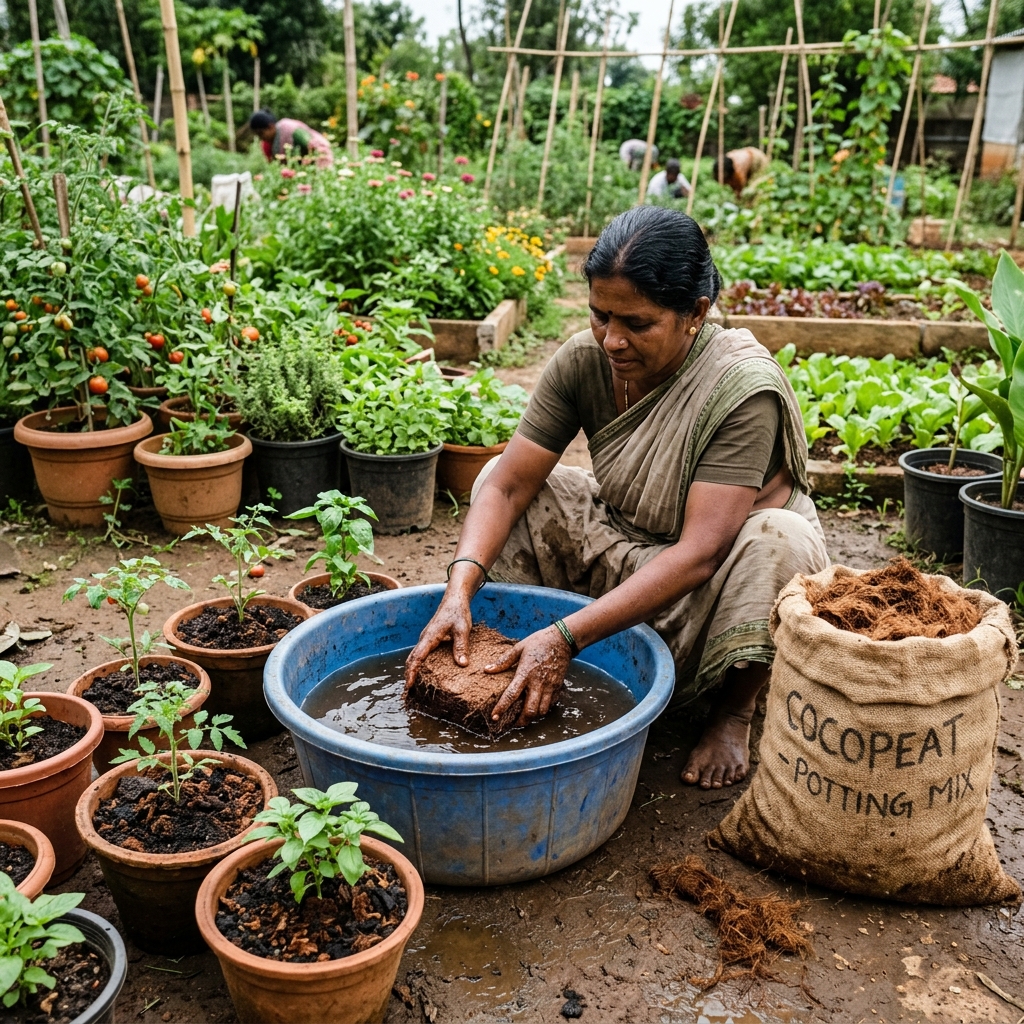
How to Prepare and Expand Compressed Cocopeat Blocks Correctly
To reduce shipping costs and carbon footprints during export, coir pith is compressed into tight 5 kg blocks, bricks, or concentrated discs. Knowing the precise protocol for preparing expanded cocopeat blocks for gardening ensures maximum volume yield and optimal pore space.

- Select an oversized container: Place your 5 kg compressed block inside a 100-liter tub, as expanded material yields up to 75 liters of fluffy growing substrate.
- Apply warm water progressively: Pour approximately 25 liters of warm water over the block. Warm water breaks compressed lignin bonds much faster than cold water.
- Allow sufficient expansion time: Let the block absorb liquid undisturbed for 15 to 20 minutes until the core softens entirely.
- Fluff and break up clumps: Use a hand trowel or gloved hands to break down remaining dense chunks, creating an even, airy texture throughout.
- Perform calcium buffering (If using unbuffered coir): Rinse the expanded substrate with a solution of calcium nitrate and magnesium sulfate to condition the CEC sites prior to planting.
Looking for Premium Sustainable Agricultural Products?
Makmur Amanah Sejahtera provides high-quality palm products such as Palm Kernel Expeller, Palm Kernel Shell, Crude Palm Oil, Palm Kernel Oil, etc. Kindly contact us at WhatsApp +6282140002198 or email us at admin@makmuramanah.co.id.
Frequently Asked Questions About Cocopeat
Does Cocopeat contain natural nutrients for plants?
No, coir pith is an inert soilless medium containing negligible nitrogen, phosphorus, or calcium. While it holds potassium traces naturally, growers must supply balanced liquid hydroponic fertilizers or slow-release organic amendments to support healthy plant growth cycles.
How long can you reuse Cocopeat in potting mixes?
High-grade washed coir lasts between 3 to 5 years without structural collapse. Between crop cycles, roots should be filtered out, accumulated salts flushed with clean water, and the substrate sterilized using steam or solarization before replanting.
Can I plant directly into 100% Cocopeat?
Yes, crops grow well in 100% coir when utilizing automated hydroponic drip irrigation systems. However, for container gardening without daily drip automation, blending 50% coir with compost and perlite provides a more forgiving moisture cushion.
What is the difference between raw and buffered Cocopeat?
Raw coir contains natural sodium and potassium ions bound to its exchange sites, which can block calcium uptake. Buffered coir undergoes calcium nitrate pre-treatment to displace sodium, ensuring stable nutrient uptake from day one.
Why is Cocopeat better than peat moss for the environment?
Peat moss extraction depletes non-renewable peat bogs that act as major global carbon sinks. Conversely, coir pith is a renewable byproduct derived from coconut harvesting, making it a ecologically responsible, sustainable growing substrate choice.

Final Thoughts on Sustainable Substrates in 2026
Transitioning toward eco-friendly, high-yielding substrates is a vital strategy for forward-thinking growers in 2026. By replacing finite topsoil and non-renewable peat moss with renewable coir pith, agricultural operations conserve precious water reserves while accelerating root development.
Integrated agricultural operations frequently combine coir substrates with sustainable crop management solutions such as RBD CP8 palm fractions to maintain sustainable production ecosystems.
Whether managing commercial greenhouse facilities or tending indoor potted plants, knowing how to leverage high-grade Cocopeat empowers you to achieve superior yields and vibrant crop health for years to come.
 English
  Indonesian
  Chinese
  Arabic