Egyptian feed mills and commercial livestock operations seeking to buy palm kernel expeller in egypt can source export-grade bulk cargo directly from Indonesia under HS Code 2306.60.90 to lower dry-matter ration costs. Processed mechanically from the oil palm fruit kernel, palm kernel expeller (PKE) delivers medium protein, digestible neutral detergent fiber, and residual lipids that provide steady ruminal fermentation for dairy cattle, beef steers, and sheep across intensive Nile Delta and desert reclamation feedlots.
Securing a steady import pipeline requires understanding container payload physics, independent quality certification, sea passage risk management through the Red Sea corridor, and nutritional boundaries. This technical guide outlines commercial specifications, shipping logistics from East Kalimantan, pricing drivers, and the verification protocols needed to buy palm kernel expeller in egypt with zero commercial surprises.
Understanding Palm Kernel Expeller for Egyptian Animal Nutrition
Palm kernel expeller, commonly known as bungkil sawit, is the solid co-product obtained after crushing oil palm kernels using mechanical screw presses. Unlike chemically extracted solvent meals, expeller-pressed PKE retains a valuable fraction of natural residual oils that enhance caloric density without causing acute ruminal acidosis.
In Egyptian ruminant rations, nutritionists classify PKE as an economical mid-protein, energy-yielding fibrous concentrate. Its cell-wall fraction consists predominantly of insoluble beta-mannans and hemicellulose. These fibers degrade slowly in the rumen, providing sustained volatile fatty acid production while maintaining a safe rumen pH above 6.2, even when total mixed rations (TMR) contain reduced forage volumes.
Egyptian compound feed manufacturers combine expeller with local by-products like wheat bran, beet pulp, and molasses. Because palm kernel expeller carries moderate crude protein alongside bypass protein fractions, it serves as a functional buffer against expensive, highly soluble protein meals.
When Expeller Is Not the Right Choice (Feed Formulator Trade-Offs)
While palm kernel expeller serves as a dependable workhorse ingredient for cattle, buffalo, sheep, and camels, it is not a universal solution for every commercial Egyptian livestock segment. Transparent procurement planning recognizes where PKE fails to perform:
- Poultry Broiler Diets: Broilers possess limited intestinal tracts and lack cellulolytic rumen bacteria. The high crude fiber (typically 14–20%) and anti-nutritional non-starch polysaccharides (mannans) in PKE accelerate digesta transit time, reduce nutrient absorption, and increase wet litter problems. Inclusion rates for broilers should remain minimal or zero unless paired with specialized exogenous beta-mannanase enzyme complexes.
- High-Density Aquaculture Rations: Nile tilapia and marine finfish require low-fiber, high-protein formulations with elevated water stability. PKE contains too much insoluble fiber and insufficient crude protein (typically 14–18%) to displace soybean meal or fish meal in intensive aquaculture feeds.
- Early-Weaned Young Stock: Young calves and lambs have underdeveloped rumens. Their immature digestive physiology cannot break down thick mannan-rich plant cell walls efficiently. PKE should be phased in only after calves transition fully to functional ruminant digestion.
For operations aiming to boost energy without adding bulk fiber, incorporating rumen-inert bypass fats like Calcium Salts of Palm Oil Fatty Acids provides concentrated caloric density tailored specifically for high-producing dairy cows during early lactation.
Key Factors When You Buy Palm Kernel Expeller in Egypt: Specifications and Particle Sizing
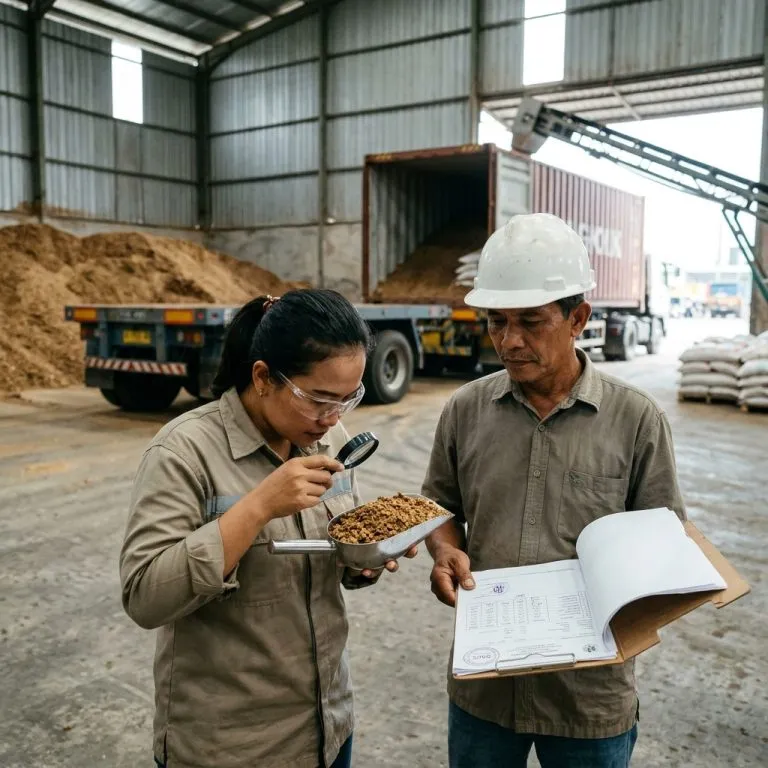
To safely buy palm kernel expeller in egypt, procurement officers must demand a verified pre-shipment Certificate of Analysis (COA) issued by reputable independent surveyors such as Sucofindo or Carsurin at the loading port. A commercial COA verifies that physical and chemical values match agreed contract thresholds before cargo departs.
The table below details standard commercial baseline ranges observed across typical Indonesian expeller shipments, highlighting what every parameter signals to an animal nutritionist:
| Nutritional Parameter | Typical Industry Range | Operational Importance for Feed Formulators |
|---|---|---|
| Crude Protein (CP) | Typically 14.0% – 18.0% | Determines inclusion rates to balance total amino acid targets alongside soybean meal. |
| Moisture Content | Typically 8.0% – 12.0% maximum | Critical control point; excess moisture triggers fungal proliferation during tropical voyages. |
| Crude Fat / Residual Oil | Typically 6.0% – 10.0% | Delivers metabolic energy; excessive free fatty acids (FFA) risk palatability drop and rancidity. |
| Crude Fiber (CF) | Typically 14.0% – 20.0% | Supplies effective rumen scratch factor; limits usage in monogastric diets like poultry and aquaculture. |
| Total Ash | Typically 3.0% – 6.0% | Measures mineral concentration; higher percentages suggest dirt, sand, or shell contamination. |
| Sand / Silica | Typically below 1.5% | Prevents abrasive wear on feed mill pelleting dies and reduces digestive irritation in cattle. |
When reviewing a laboratory certificate, look closely at moisture and fat ratios. Cargo loaded above 12% moisture risks biological heating inside closed shipping containers during transit through equatorial passages and the Indian Ocean. Every shipment originating from certified mills must supply batch-specific lab testing. For complete certified technical datasheets and current testing results, explore how to buy palm kernel expeller in egypt directly from source mills.
Physical Forms: Kasar (Coarse Flake) vs Halus (Fine Ground)
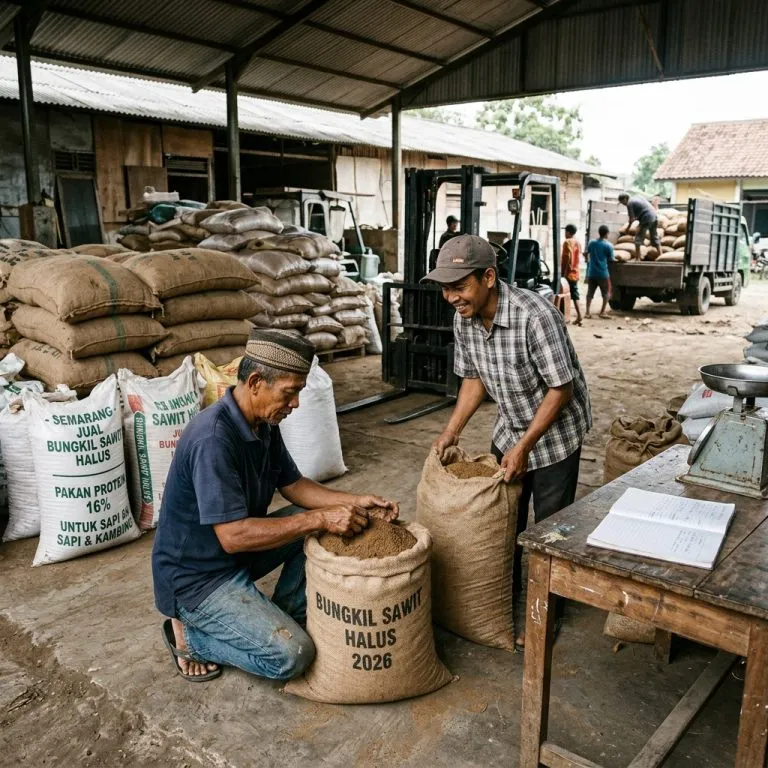
Indonesian processing facilities offer expeller in two physical states: unground coarse flakes (kasar) and hammer-milled fine meal (halus), screened to a 1–3 mm particle profile. Selecting the appropriate texture affects handling efficiency at Egyptian discharge terminals, storage bin flowability, and direct feed intake.
| Feature / Attribute | Kasar (Coarse Flake) | Halus (Fine Ground 1–3 mm) |
|---|---|---|
| Particle Size | Irregular flakes, up to 10–15 mm | Uniformly ground to 1–3 mm mesh |
| Bulk Density | Standard bulk density (500–550 kg/m³) | Higher bulk density (600–650 kg/m³) |
| Pelleting Performance | Requires secondary milling at the buyer facility | Directly integrates into batch mixers and pellet dies |
| Container Payload | ~20 Metric Tons per 20ft FCL | Up to 23–24 Metric Tons per 20ft FCL |
| Palatability & Dustiness | Low dust, slower ruminant ingestion rate | Higher dust potential; blends evenly into TMR mixes |
Feed mills in Alexandria and industrial zones around Cairo with internal hammermills often prefer coarse expeller because it retains cellular fiber structure. Conversely, operations producing uniform 4 mm or 6 mm ruminant pellets choose fine-ground expeller (halus) to skip primary milling, cut energy consumption, and pack higher tonnages into each ocean container.
If you require alternative tropical protein meals to balance fibrous rations, compounders frequently blend expeller with Copra Meal, which offers complementary fiber digestion characteristics and pleasant aroma profiles for dairy herds.
Container Logistics and Payload Economics for Egyptian Buyers
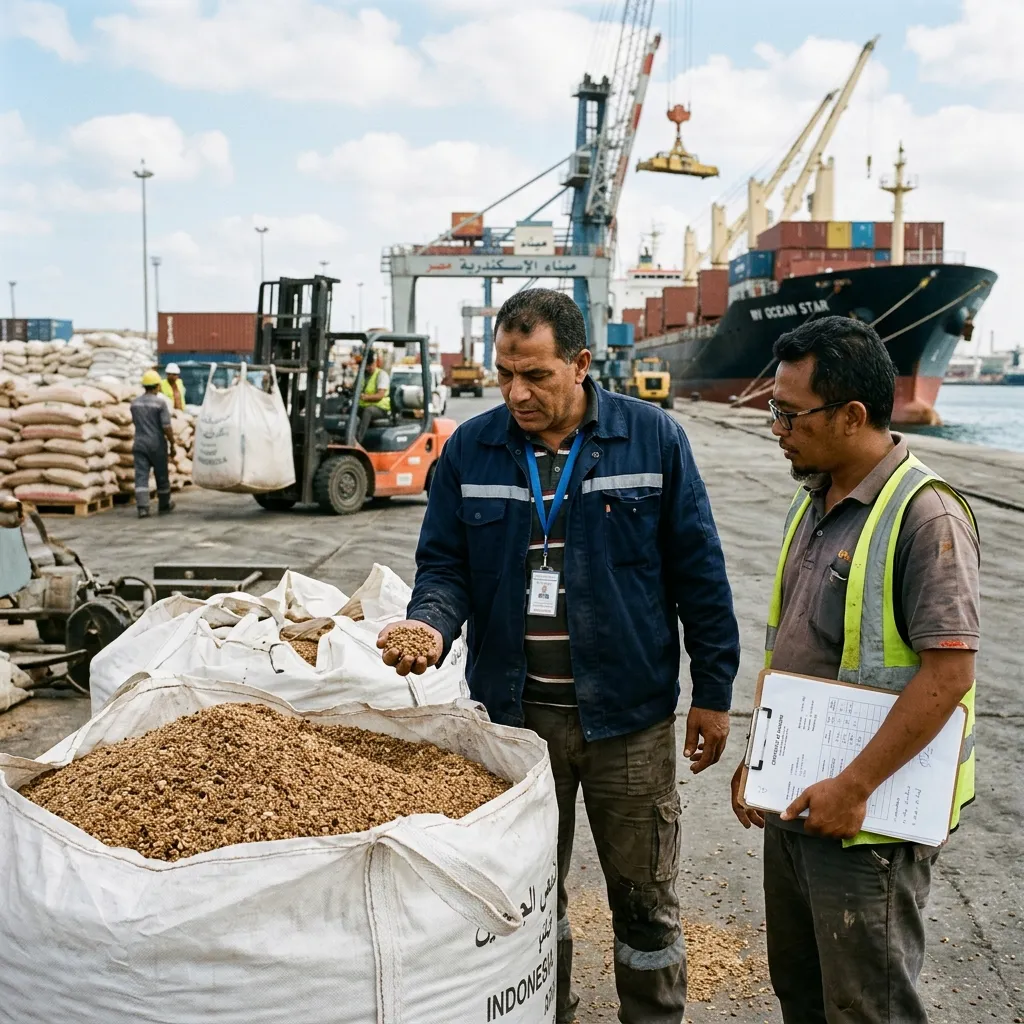
Freight rates per container represent a significant percentage of the landed CIF cost at Egyptian container terminals such as Dekheila, Alexandria, Damietta, or Port Said. Optimizing net payload per twenty-foot container (20ft FCL) directly reduces landed cost per metric ton.
Standard coarse PKE loaded in 50 kg polypropylene bags fills container cubic capacity before reaching maximum allowable weight limits, typically yielding 20 metric tons per 20ft box. By contrast, fine ground expeller boasts higher bulk density, allowing shippers to load between 23 and 24 metric tons per container, whether packed in 50 kg bags or gravity-fed into dry bulk container liners.
Payload Planning to Buy Palm Kernel Expeller in Egypt Efficiently
When commercial feed buyers plan to buy palm kernel expeller in egypt, container payload volume dictates total shipping efficiency. Maximizing metric tonnage inside every twenty-foot box reduces ocean freight amortized across each feeding ration.
Illustrative Container Freight Arithmetic
Consider the following worked example showing how payload density impacts landed ocean freight costs per metric ton. The numbers below serve as a mathematical demonstration of logistics economics:
- Hypothetical Ocean Freight: $1,600 USD per 20ft dry container from Samarinda Palaran Port to Alexandria Port.
- Scenario A (Standard Coarse Bagged): 20 metric tons payload per container.
Freight Allocation Formula: $1,600 / 20 MT = $80.00 USD freight per ton. - Scenario B (High-Density Fine Ground Bagged): 23.5 metric tons payload per container.
Freight Allocation Formula: $1,600 / 23.5 MT = $68.09 USD freight per ton. - Net Freight Savings: $80.00 – $68.09 = $11.91 USD per metric ton saved purely through physical density optimization.
On a 500-metric-ton order, maximizing container payload reduces total ocean transportation expenditures by nearly $6,000 USD without changing the base FOB raw material cost. Industrial biomass buyers looking to streamline multipurpose shipments can also review Palm Kernel Shell for industrial boiler heating requirements.
The Pre-Order Decision Checklist to Buy Palm Kernel Expeller in Egypt
When preparing to buy palm kernel expeller in egypt, complete this operational checklist before opening a commercial documentary Letter of Credit (L/C) or releasing an advance T/T wire:
- Define Exact Milling Granulometry: Confirm whether your formulation plant requires unground coarse flakes (kasar) or pre-crushed fine meal (1–3 mm halus).
- Specify Moisture and FFA Thresholds: Set maximum contractual limits for moisture (typically ≤ 10-12%) and crude fat to prevent biological heating on long ocean passages.
- Agree on Packaging Type: Select between new 50 kg woven polypropylene bags (easier breakbulk handling at local warehouses) or bulk container liners (requires tilting unloader equipment at Egyptian feed mills).
- Mandate Independent Surveyor Testing: Stipulate pre-shipment sampling by recognized agencies (Carsurin or Sucofindo) covering protein, moisture, fat, fiber, sand/silica, and ash. Paid physical lab samples should be inspected prior to vessel departure.
- Confirm Export Permit Clearances: Verify that the exporter holds valid Indonesian export documents, including PEB (Pemberitahuan Ekspor Barang) and NPE permits, along with GACC China registration protocols where relevant.
- Review Mandatory Egyptian Import Documents: Ensure the origin supplier can furnish original Bills of Lading, Phytosanitary Certificates issued by the Indonesian Agricultural Quarantine Agency, Fumigation Certificates, commercial invoices, packing lists, and Certificates of Origin (COO).
Step-Step Import and Documentation Workflow to Egyptian Ports
Importing animal feed co-products requires strict alignment between Indonesian customs clearance and the Egyptian General Organization for Export and Import Control (GOEIC) requirements. The following chronological timeline details how a typical containerized contract moves from port to port:
- Sales Contract and Payment Finalization: Buyer and seller conclude standard trade contracts governed by Incoterms (FOB Samarinda, CFR Damietta, or CIF Alexandria). Payment terms are confirmed via irrevocable Letter of Credit at sight or structured Telegraphic Transfer (T/T).
- Cargo Preparation and Lab Inspection: The processing facility screens the expeller to the chosen mesh grade at the Samarinda processing plant. Independent inspectors (Carsurin or Sucofindo) take composite samples from the staging warehouse to run certified proximate assays.
- Container Stuffing and Fumigation: Goods are loaded into dry 20ft containers at the Palaran Terminal in Samarinda, East Kalimantan. Containers undergo mandatory phosphine or methyl bromide fumigation to eradicate wood-boring and agricultural pests in accordance with quarantine protocols.
- Export Quarantine and Customs Clearance: The local quarantine authority issues an official Phytosanitary Certificate. Indonesian customs processes the export declaration (PEB) and issues the customs export permit (NPE).
- Maritime Transit: Feeder vessels carry containers from Samarinda to regional transshipment hubs (such as Jakarta or Singapore) before mother vessels navigate deep-sea routes across the Indian Ocean and Red Sea to discharge at Alexandria, Damietta, or Port Said.
- Document Presentation and Cargo Release: The seller presents the full original document dossier (B/L, Phytosanitary Certificate, Fumigation Certificate, COA, Packing List, Invoice, and COO) through banking channels. Egyptian customs brokers process import clearance, inspect physical seals, take quarantine counter-samples, and release the cargo for domestic trucking.
While domestic sales in Indonesia concentrate in commercial hubs such as Surabaya, Semarang, and Jakarta, all international export shipments stage directly from deep-water river ports in Kalimantan to ensure freshness and immediate traceability.
Maritime Transit Risks, Storage, and Quality Red Flags
Procurement teams who regularly buy palm kernel expeller in egypt monitor three major quality hazards during ocean transit: moisture migration, fungal contamination, and spontaneous heating.
Because sea transit from East Kalimantan to Egyptian Mediterranean terminals spans several weeks, ambient temperature fluctuations across changing latitudes can cause condensation inside closed shipping containers. This phenomenon, known as container sweat, causes moisture to accumulate on interior ceiling panels and drip onto the top bag layers.
- Moisture Migration and Mold: If expeller is packed with moisture content above 12%, warm air carrying water vapor rises to the surface and condenses. This triggers mold growth, specifically Aspergillus and Penicillium strains, raising mycotoxin concerns. Contract specifications should stipulate dry packaging, container desiccants, and moisture levels below 10-12%.
- Spontaneous Biological Heating: Expeller contains residual lipids (typically 6–10%) and organic fibers. If exposed to elevated moisture, bacterial activity accelerates, driving internal cargo temperatures upward. In severe cases, prolonged self-heating degrades digestible amino acids, darkens the meal, and burns the feed.
- Rancidity and High Free Fatty Acids: Storing high-oil meal in hot, humid conditions breaks triglycerides down into free fatty acids (FFA). Ruminants avoid oxidized, foul-smelling feed, which suppresses dry matter intake in milking dairy cows.
- Sand, Shell, and Debris Adulteration: Inadequate screening at palm kernel crushing plants leaves excessive broken endocarp shells and abrasive silica. High sand content acts as non-nutritive filler that rapidly erodes commercial pelleting dies and reduces ration value.
To inspect global standards for safe handling and quality parameters of animal feeds, importers can reference feed safety guidelines maintained by the Food and Agriculture Organization (FAO).
What Drives Palm Kernel Expeller Price per Ton for Egyptian Importers?
When feed mill managers budget to buy palm kernel expeller in egypt, price movements reflect complex global commodity interactions rather than domestic Egyptian demand alone.
First, palm kernel crushing rates depend directly on global Crude Palm Oil (CPO) production volumes. When Malaysian and Indonesian fresh fruit bunch (FFB) harvesting hits seasonal monsoon peaks or slumps, kernel supply moves accordingly. Second, international substitute markets—especially Chicago Board of Trade (CBOT) soybean meal and corn futures, tracked closely through the USDA Foreign Agricultural Service—establish competitive price ceilings for energy and protein feedstuffs.
Third, ocean container freight rates between Southeast Asia and Mediterranean transit corridors dictate landed import costs. Shifts in container equipment availability, bunker fuel costs, and Red Sea shipping routing instantly adjust CFR Alexandria and Damietta landed values. Fourth, Indonesian export taxes and palm levy policies set by regulatory agencies directly impact FOB invoice rates. Finally, local currency exchange rates between the Egyptian Pound (EGP) and the US Dollar (USD) dictate import affordability and letter of credit processing velocity.
More detailed background on raw material origin and historical crushing co-product yields can be explored via Wikipedia’s Palm Kernel Meal overview.
Makmur Amanah Sejahtera provides high-quality palm products such as Palm Kernel Expeller, Palm Kernel Shell, Crude Palm Oil, Palm Kernel Oil, etc. Kindly contact us at WhatsApp +6282140002198 or email us at admin@makmuramanah.co.id.
Frequently Asked Questions About PKE Imports in Egypt
What is the typical protein and fiber content of imported PKE?
Palm kernel expeller typically contains 14% to 18% crude protein and 14% to 20% crude fiber. These values vary depending on the palm kernel origin and mechanical extraction efficiency. Exact contractual nutrient guarantees must always be verified on the official Certificate of Analysis provided with each shipment.
Can Egyptian feed mills request physical product samples before ordering?
Yes, buyers can obtain certified physical samples pulled by independent inspection agencies such as Carsurin or Sucofindo. Because laboratory sampling, handling, and air courier dispatch require independent verification, samples are provided on a paid basis rather than free of charge to confirm serious buyer intent.
How much palm kernel expeller fits into a standard 20ft container?
Standard coarse (kasar) expeller packed in 50 kg woven polypropylene bags normally loads around 20 metric tons per 20ft container. High-density fine ground meal (halus) packs tighter, allowing loading volumes of 23 to 24 metric tons per container, significantly reducing freight costs per ton.
What documents are required to clear PKE through Egyptian customs?
Clearing PKE through Egyptian ports requires original Bills of Lading, a Phytosanitary Certificate issued by quarantine authorities, an independent surveyor Certificate of Analysis (COA), a Fumigation Certificate, a Certificate of Origin (COO), commercial invoices, packing lists, and export declaration documentation (PEB/NPE).
Can PKE be fed directly to dairy cattle without secondary processing?
Yes, coarse expeller can be incorporated directly into on-farm Total Mixed Rations (TMR) for dairy and beef cattle. However, commercial feed mills formulating uniform compound feed pellets prefer fine-ground expeller (1–3 mm) to optimize batch mixing and reduce mechanical wear on pelleting equipment.
Conclusion
Deciding to buy palm kernel expeller in egypt allows feed manufacturers and commercial livestock operations to secure an economical, rumen-safe protein and energy source that cushions feed budgets against grain price volatility. By choosing between coarse flakes and high-density fine meal, demanding pre-shipment lab verification via Sucofindo or Carsurin, and maximizing ocean container payloads, Egyptian importers can stabilize their supply chain while protecting animal performance across all commercial ruminant feeding systems.
By maintaining disciplined contracting, livestock producers who buy palm kernel expeller in egypt can build reliable rations that safeguard herd productivity over long-term production cycles.
Basis of this guide: Company operational specifications, loading configurations, and inspection protocols originate directly from the company fact sheet. General nutritional ranges and chemical parameters reflect typical industry baselines and must be confirmed against the independent Certificate of Analysis (COA) of each specific shipment.